
Creating content that ranks well on search engines is harder than ever. Marketers face endless research, shifting algorithms, and the pressure to deliver results fast.
I’ve seen how traditional writing tools fall short—they polish grammar but don’t help your content compete for top spots. That’s where SEO content writing software steps in, offering real-time optimisation, competitor analysis, and workflow automation all in one place.
In this guide, I’ll break down exactly what sets these platforms apart from generic writing or keyword tools. You’ll see how features like live SEO suggestions, integrated analytics, and CMS publishing can streamline your process and improve your results.
I’ll also compare leading solutions, share practical use cases, and outline how AI and automation are changing the game. By the end, you’ll know how to pick the right software for your needs—and how to get the most out of it.
What is SEO content writing software?
Definition and scope of SEO content writing software
Let’s jump in. SEO content writing software is designed to help marketers and writers create web content that stands out in search results—not just look good on the page.
These aren’t your typical writing apps. They go beyond spelling and grammar, automating SEO essentials like keyword integration, live optimisation prompts, and competitor SERP (Search Engine Results Page) analysis—right inside your workflow. The aim? Streamline content production and make sure your writing matches what search engines want.
- Integrated Keyword Research
Finds the best keywords and key topics for your content. - Content Briefs & Outlines
Suggests structures and must-cover points to maximise SEO. - Live Optimisation Suggestions
Delivers real-time advice on keywords, structure, and readability as you type. - Competitor SERP Analysis
Checks your draft against top-performing pages for that keyword. - Internal Linking & Publishing
Supports your internal links and connects to leading CMS platforms. - Content Analytics & Maintenance
Tracks results and offers ideas for updates after publishing.
Here’s the big differentiator: these tools aren’t just English tutors like Grammarly. They have SEO logic built in.
And they’re not just keyword sources like Ahrefs or SEMrush. SEO writing platforms give real-time, actionable guidance as you write, plus support for launching your content.
Core differences from generic writing and keyword tools
So, what really sets these platforms apart from standard writing or keyword tools?
SEO content writing software brings live, search-focused feedback straight into your drafts. Solutions like Surfer SEO, Frase, and Clearscope let you benchmark against competitors, sometimes even publish directly—no endless tool switching.
Traditional writing apps help you polish grammar, but aren’t made for search rankings. Keyword tools give you data, but you’re left to put everything together yourself.
| Feature/Tool Type | SEO Content Writing Software | Generic Writing Tools | Keyword Research Tools |
|---|---|---|---|
| Real-time SEO optimisation | Yes: built in | No | No |
| Editor with SEO briefs | Yes: outlines/advice | No | No |
| Competitor benchmarking | Yes: in-editor | No | Separate from writing |
| Publishing/CMS integration | Supports CMS | Basic or none | No |
| Grammar/style checking | Usually basic | Advanced | No |
Why SEO content writing software matters
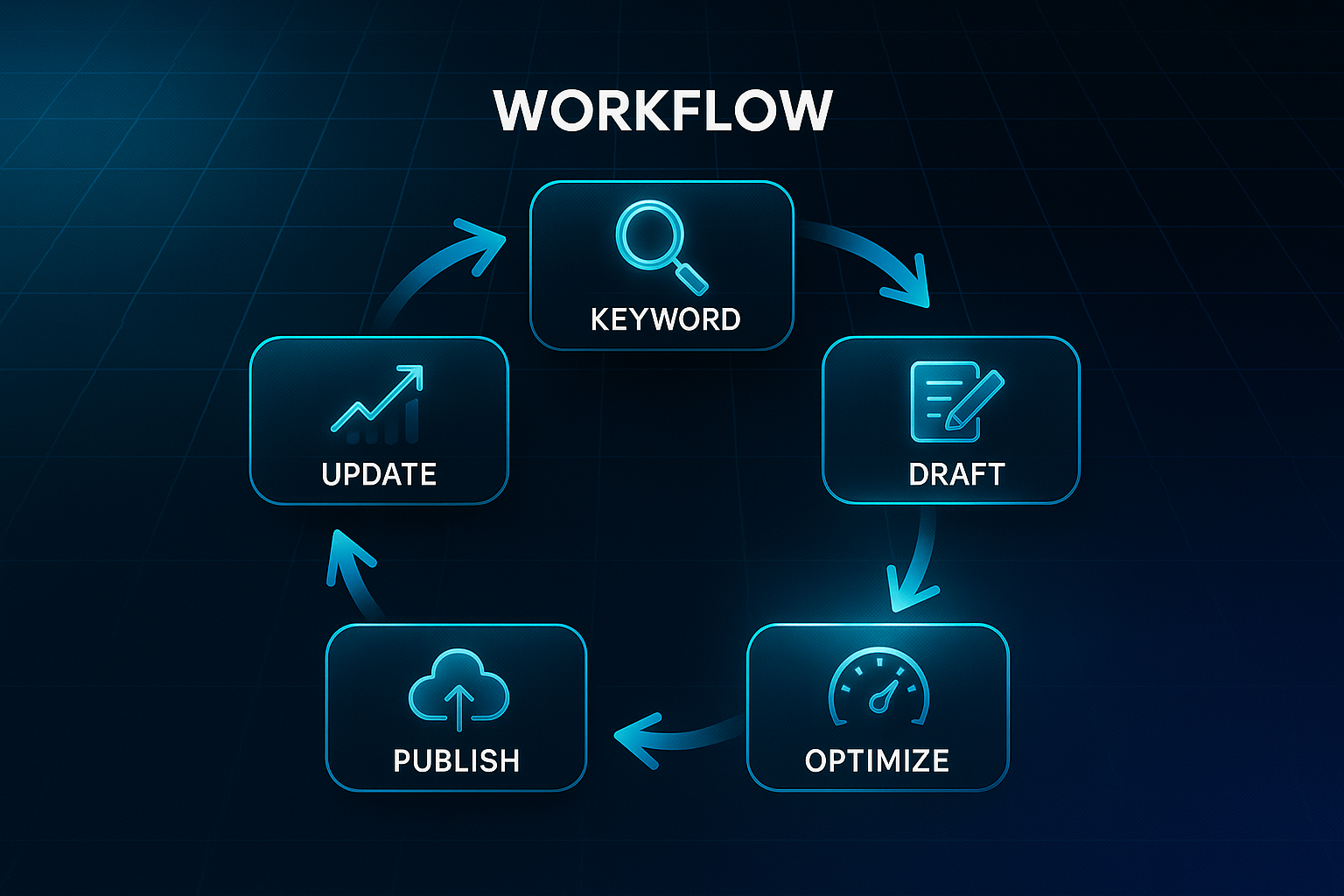
Why does this matter? It means marketers can move from research, to drafting, to optimisation—all in the same place.
With your content shaped around real search intent and trends, you’ve got a stronger chance of attracting qualified visitors.
Teams get greater efficiency, higher quality, and marketing ROI they can actually measure. Built-in analytics and update reminders help you refine your approach—boosting organic growth in today’s tough competition.
Benefits and core use cases of SEO content writing software
Efficiency and quality improvements
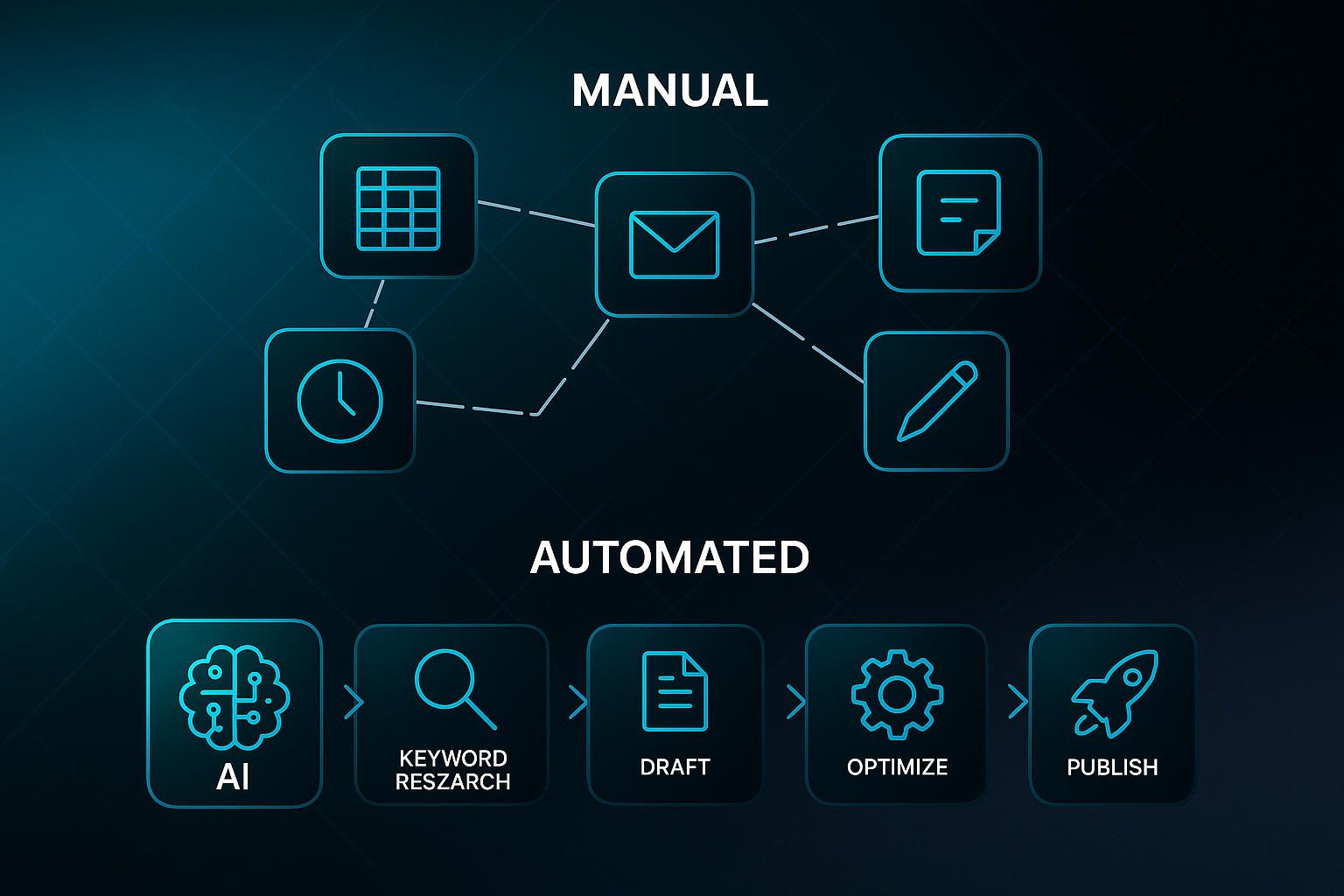
Let’s face it—writing brilliant, search-friendly content is time-consuming. This is where SEO content writing software really changes things up. Automated keyword research, drafting assistance, and SEO-focused editing handle those repetitive jobs so you can focus on creating.
Instead of spending hours slogging through manual research, you’ll have quality first drafts in minutes. The AI-powered suggestions nudge you along—helping with structure and keywords, so your content works for both people and search engines.
I find the built-in grammar and style checks to be a quiet game-changer. You don’t waste hours proofreading, but still publish cleaner, more SEO-aligned content. For marketing teams, the difference is dramatic. Many double their monthly blog or article output just by automating more of the process.
By streamlining their SEO workflows, Planable multiplied their content output by 10x, and their traffic graph shows a consistent upward trajectory.
Your whole workflow moves from slow and manual to creative and fast.
Consistency and competitive advantage
Brand consistency can slip when lots of people are writing—but these tools prevent that. Flexible style and tone settings keep every post on-brand.
The serious edge? Live benchmarking features compare your work to top competitors, offering practical advice so you stand out. What’s clever is how these SEO content platforms adapt automatically to changes in search engine algorithms, updating their advice in the background.
So, when Google shakes up its results, you’re already adjusting your content, keeping your ranking safe in a competitive arena.
Key use cases by role
So who gets the most impact here? Agencies with lots of clients, in-house teams wanting smoother approvals, SMEs scaling up output, and enterprises with huge content portfolios—all gain a real advantage.
Launching hundreds of optimised blog posts or product pages each quarter? SMEs now find it possible with smart automation.
For hands-off, high-output solutions, agency-led offerings like SEOSwarm by Precision AI Marketing bundle it all: AI-driven writing, expert input, quality checks, publishing, and proactive SEO updates. That means high-volume content with barely any manual drag—so you keep pace in even the fastest-moving digital scenes.

AI-Powered
SEO Content Strategy
See the AI platform that's replacing entire content teams
(with better results).

Key features and functionalities of SEO content writing software
Must-have features in modern platforms
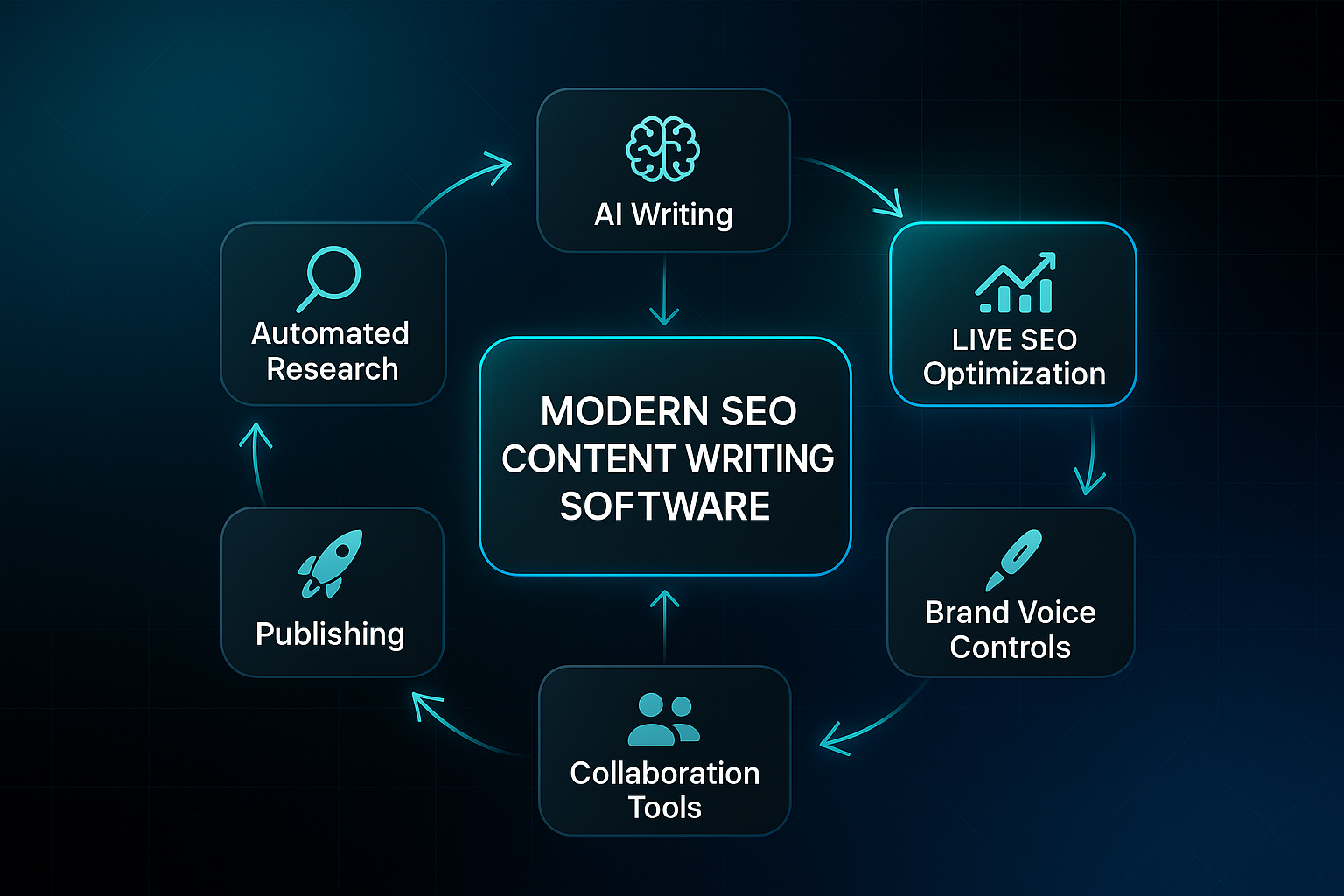
SEO content writing software isn’t what it used to be. These days, AI-powered platforms take you from the initial idea to the moment you hit publish—without missing a beat.
What features are non-negotiable in a modern solution?
- Automated Topic Research & Briefs
Analyses SERPs and competitors to generate focused outlines and keyword ideas. - AI Writing with Brand Voice Controls
Delivers drafts that align perfectly with your chosen brand tone. - Live SEO Optimisation
Gives up-to-the-minute feedback on keywords, structure, and readability as you write. - Competitor Benchmarking & Gap Analysis
Spots content gaps and shows how you compare with top-ranking pages. - Quality Checks
Instantly checks for grammar, readability, and originality—straight in the editor. - Collaboration & CMS Integration
Lets teams work together and quickly publish to platforms like WordPress. - Bulk Meta & Content Updates
Handles mass changes like meta descriptions or content audits in one go. - Media Integration & Templates
Speed things up with visuals and ready-made content structures.
This range of tools means you can research, write, and optimise faster—while keeping things consistent and top quality, even for remote or distributed teams.
Comparison of top solutions by feature
So how do leading platforms actually differ? The answer lies in the details—each has a core strength that makes it a better fit for some use cases than others.
Here’s a quick head-to-head:
| Platform | Automation | Optimisation | Bulk Workflows | Analytics | CMS Integration | Brand/Tone Controls | Distinctive Feature |
|---|---|---|---|---|---|---|---|
| Semrush | AI writing, topic ideas | Live SEO, SERP analysis | Unlimited articles | SERP & competitor analytics | WordPress, Chrome | Voice options | Localised briefs |
| Surfer SEO | AI content, brief builder | Real-time NLP recs | Templates | Internal linking, readability | Images, linking | Custom guidelines | AI SEO audits |
| Frase | Batch outlines, AI briefs | SEO score, gap checks | Multi-doc briefs | SERP, topic gap | WordPress, Google Docs | Tone templates | Answer extraction |
| Scalenut | AI drafting, clusters | Scoring, competitor checks | Batch creation | SERP dashboards | WP, Chrome, Google Docs | Tone settings | Topic clustering |
Semrush and Surfer SEO are ideal for agencies or ecommerce sites with lots of content to optimise. Publishers producing stacks of research briefs often favour Frase, while B2B marketers can make the most of Scalenut’s topic clustering.
Making the right match for your workflow and industry genuinely unlocks maximum value.
Agency-led and managed model distinctions
But what about organisations wanting more than just clever software? For teams needing quality assurance, compliance, or long-term SEO updates, agency-managed solutions stand apart.
Here's where SEOSwarm by Precision AI Marketing comes in. Once your strategy is signed off, their experts plus smart AI handle everything—research, writing, optimisation, publishing, and updates—no ongoing micromanagement needed.

Human editors review each piece for SEO, EEAT, and your brand’s character. The result is enterprise-level consistency and confidence, so even heavily regulated industries or large organisations can scale SEO content without extra internal burden.
How AI and automation are transforming SEO content writing
AI-driven keyword, structure, and optimisation advancements
It’s genuinely impressive how quickly AI is reshaping SEO writing. Tools like Surfer SEO, SEMrush, Frase, and LowFruits aren’t just extras now—they’ve become central to how marketers unearth keywords and structure each piece.
These platforms use live SERP monitoring to reveal not just obvious keywords, but specific long-tail gems that older methods often miss. SEMrush’s Keyword Magic Tool, for example, filters real-time search and competitor data to spot trends, letting marketers jump on new opportunities fast.
How do so many blogs get their structure so right? The secret’s now out—AI. Surfer SEO and Frase build detailed outlines using high-performing pages as a template, suggesting everything from headings to sections. The hard research is seriously cut down, with tools mapping out what’s proven to work in search.
Platforms like LowFruits push things further with predictive analytics—data models that assess ranking difficulty and forecast content performance.
It lets teams choose high-impact topics and see when old pages need a refresh. The results? Surfer SEO users often see production times halved, and SEMrush users report a 38% increase in page-one rankings for B2B after introducing AI guidance.
An analysis of multiple implementations reveals that AI-driven SEO is a proven methodology for effectively scaling organic traffic.
The new workflow: Human-AI collaboration
What’s really critical here is the way workflows have shifted. AI now deals with bulk research, idea generation, outlines, SEO scoring, gap analysis, and performance checks—freeing up human editors for creative and compliance work.
But humans remain vital: editors bring a unique voice, ensure compliance, and handle those all-important accuracy checks—especially in sectors with tight regulations. Subject matter experts sign off for Experience, Expertise, Authoritativeness, and Trustworthiness (EEAT), a major part of Google’s guidelines.
Hybrid workflows—AI for scale, humans for finesse—are now proven winners. Agencies using Frase or Surfer SEO combine automated research and drafting with final human review, doubling or even tripling their output while upholding standards. And as Google’s latest guidance confirms, AI content is welcomed if it’s valuable and original, provided EEAT remains front and centre. This blend lets teams move faster, maintain quality, and stay nimble as algorithms evolve.
Top SEO content writing software platforms: A comparison
Market leaders in 2024–2025
Take a look around the SEO world in 2024–2025, and you’ll spot a few names leading the way. Platforms like Semrush Content Toolkit, Surfer SEO, Clearscope, Frase, Scalenut, SE Ranking, and Writer have staked their claim. Each approaches SEO content writing with its own flavour, catering to everyone from agile agencies to complex enterprises.
But what makes them so popular? For most users, it’s a brilliant blend of speed, quality, and advanced optimisation features that seriously raise the bar on results.
Platform-by-platform breakdown
Let’s break down how each contender stands out.
Semrush Content Toolkit is a comprehensive suite offering AI-fuelled writing, workflow automation, image creation, and a huge array of integration options. Agencies and large brands love the way it manages publishing at scale—one European retailer sped up its content process by 42% thanks to automated briefs and rapid audits.

Source: semrush.com
Surfer SEO wins big with real-time optimisation, live SERP analysis, and smart keyword suggestions. Their API is a game-changer for bulk publishing. One SaaS company using Surfer saw a 31% increase in leads after automating their production.

Surfer Product Demo: Master Content Optimization
Clearscope is built for clarity and strategic analytics. Its standout content scoring and deep gap analysis help large teams pinpoint weaknesses across sprawling websites. Plus, that Google Docs integration makes it easy to slot into existing workflows.

How to Use Clearscope for Content Creation & Update
Frase focuses on efficiency—streamlining research, outlining, and scoring for busy marketers. With its intuitive templates and fast topic tools, one B2B team halved article turnaround times after switching.
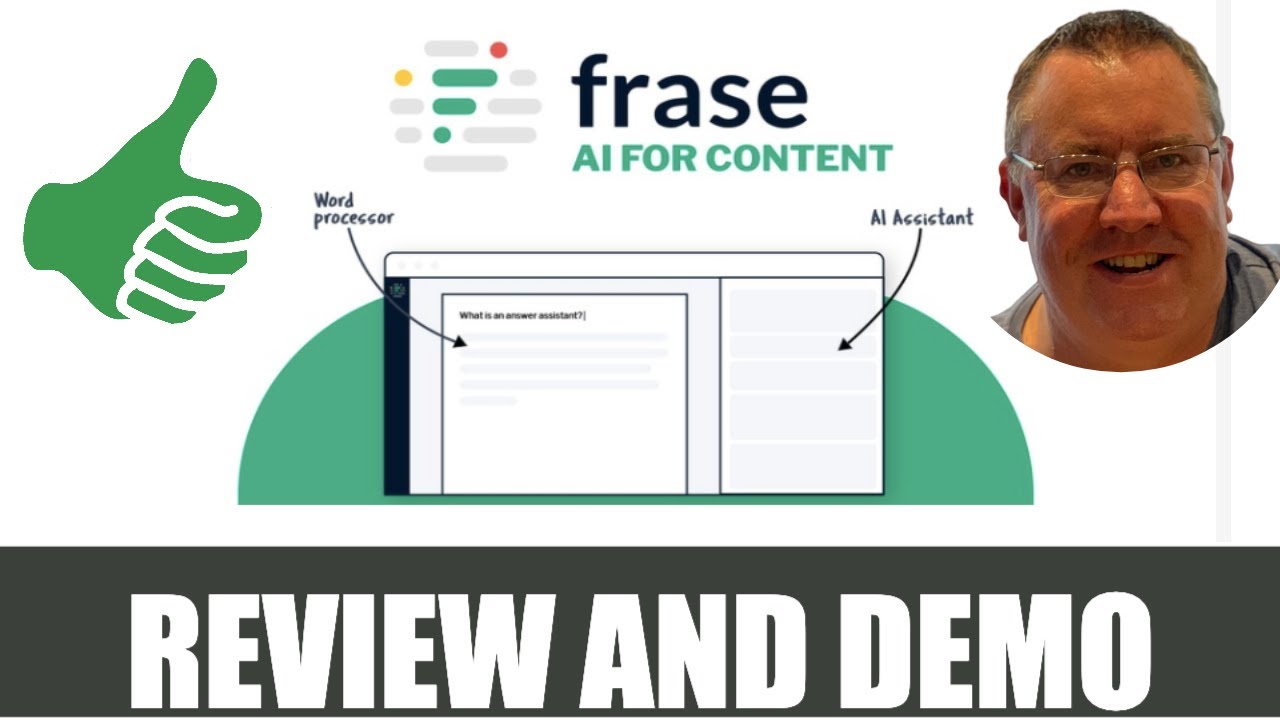
Frase Review and Demo - 🔥🔥 Honest Review🔥 Free Access 🔥
Scalenut gets high marks for in-depth topic analysis and AI writing. Agencies handling lots of campaigns can double their content volume without needing extra hands, all thanks to clever automation features.

Scalenut Review | How To Write Blog Post Using AI | SEO Optimized Articles | Scalenut Cruise Mode
SE Ranking covers all bases: content editing, competitor tracking, site audits, and project management. For hybrid SEO/content teams, it’s an all-in-one solution—great for keeping everything coordinated.

SE Ranking Review & Demo Tutorial 2022: Is It The Best All-In-One SEO Software?
Writer answers the needs of bigger organisations with strict rules. If you’re in finance or healthcare, it’s all about brand consistency and compliance at scale, enforced by analytics and robust controls.

How Writer's A.I. Applies Style and Brand Guidelines at Scale
Real-world results
And what sort of impact do these platforms have in practice? Agencies using Scalenut’s automation regularly double deliverables for clients. Retailers deploying Semrush slash briefing hours by more than a third. Writer helps global brands maintain a unified voice and cut out editorial slowdowns.
When you pair the right solution with your workflow, you unlock serious scalability and sharper search performance—no matter how fast digital marketing moves.
How to choose the right SEO content writing software for your needs
Key selection criteria
How do you find SEO content writing software that truly fits your team? The key is matching what a platform can do to what your everyday work demands—because what helps a small in-house team may frustrate a growing agency.
Here are the criteria you’ll want to keep at the top of your checklist.
Scalability for evolving content operations
If you’re planning to ramp up publishing or expand into new markets, choose a platform built for growth. Look for trusty batch publishing and API support to automate when extra speed is needed.
Deep workflow and CMS integration
Content bottlenecks stall teams. Direct connections to major platforms—like WordPress or HubSpot—cut out editing confusion and delays, so your drafts go live faster.
Brand control, template enforcement, and localisation
Juggling multiple brands, regulated industries, or several languages? Go for template locking, strong brand voice features, and support for easy localisation, so quality and compliance hold steady.
Advanced SEO, analytics, and compliance automation
Live gap analysis, schema markup, and audit trails are must-haves in regulated sectors or for anyone dreading SEO errors. They flag gaps and catch issues before they hurt rankings.
Ease of onboarding, adoption, and support
Nobody wants a tech headache. The easiest tools offer quick setup, clear controls, and plenty of help—so teams can hit the ground running.
Predictable pricing and ROI alignment
What’s the smartest spend as you scale? Agencies often pick “unlimited” plans for budget clarity, while smaller outfits might lean towards flexible, modular pricing.
Security, privacy, and compliance requirements
If you fall under GDPR, HIPAA, or industry controls, platform compliance is non-negotiable. Avoid risky platforms to stop legal headaches or sudden takedowns.
Best practices for evaluation and adoption
So, how do you move from shortlist to final choice? A few best practices really matter.
Map features to workflow challenges
Spot major content struggles—translations, compliance, or mass updates—and confirm if each option solves your real-world problems.
Run scenario-based pilot phases
Don’t just skim specs. Test contenders on your actual process to see if you get the speed, quality, and compliance you need.
Prioritise change management and support
Loop in IT, legal, and editors from the start. Helpful onboarding and ongoing support ensure not just adoption, but long-term content success.
With the right fit, your SEO content approach becomes both easier—and much more effective.
SEOSwarm by Precision AI Marketing: The agency-powered SEO content solution
How SEOSwarm works: A hands-off, high-quality approach
Picture this: you hand over your SEO content needs and hardly have to lift a finger after strategy sign-off. That’s the experience SEOSwarm delivers. Operating as a truly managed, agency-led platform, Precision AI Marketing’s team steps in from day one—crafting a strategy, getting your thumbs up, and then running the whole show.
Once the plan is approved, everything else is orchestrated by a blend of seasoned marketers and specialised AI agents. That means you’re free from the usual headaches like lengthy research, drafting, optimisation, formatting, publishing, or the grind of ongoing updates. Essentially, all the process tedium disappears on your side—your path to organic growth just got a lot smoother.
- Full-service, agency-managed process
You only approve the initial strategy; all research, writing, editing, optimisation, publishing, and updates are expertly managed for you. - AI agents for deep research and optimisation
Special AI handles research, content creation, keyword optimisation, internal links, and schema markup—making the whole process more reliable and much faster. - Human experts for quality and oversight
Real SEO strategists drive the planning, ensure editorial standards, check EEAT, and steer continuous improvement using analytics.
Key features and advantages of SEOSwarm
So, what sets SEOSwarm apart from the other options out there? Let’s dive in.
- End-to-end strategy & content lifecycle
SEOSwarm runs everything—topic picking, content creation, publishing, audits, and scheduled refreshes—meaning you avoid content bottlenecks and manual tasks entirely. - Superior content and ongoing analytics
Every article is quality-checked by humans and optimised, with analytics feeding improvements to EEAT, branding, and SEO performance. - Performance monitoring and instant blog setup
You get direct publishing, auto-indexing with Google Search Console, plus a 'blog-in-one-minute' set-up for speedy launches. - Real cost, speed, and scale advantages
Automation and agency teamwork make SEOSwarm both more affordable and faster than standard agencies or doing it in-house. - No DIY headaches or risks
SEOSwarm is not a traditional SaaS—you’re never left to operate tools alone; experts guarantee consistent, expertly managed output every step of the way.
Ever wished you could skip the drudgery and just see powerful SEO content appear where you need it, up-to-date and always improving? That’s exactly what SEOSwarm was built for.

Misconceptions and FAQs about AI and SEO content writing software
Debunking AI and SEO software myths
Modern AI tools and content quality
People often claim AI-written material is low quality, but leading software today produces fluent, well-structured drafts and turbocharges content workflows.
That said, only human input adds real depth and unique voice—especially when you need true expertise or high-value insight.
Google’s approach: Quality, not authorship
Here’s a common question: does Google penalise AI-written content? In reality, Google ranks content by quality, expertise, and user value—regardless of who (or what) wrote it.
Websites full of thin, unchecked content risk penalties, but when you polish AI drafts with editorial improvements, you get powerful and stable SEO outcomes.
Why human oversight still matters
So, why not just fire up the AI and publish? Editorial review still matters. It's humans who ensure every article passes the bar for accuracy, compliance, and brand style.
Teams blending human review with AI drafts spot more errors, build trust, and drive higher engagement.
The hybrid model: Superior ROI and quality
Here’s the thing—using AI for drafts plus expert human edits means content production is far faster and safer. This hybrid approach scores higher rankings and better user satisfaction than sticking to humans or machines alone.
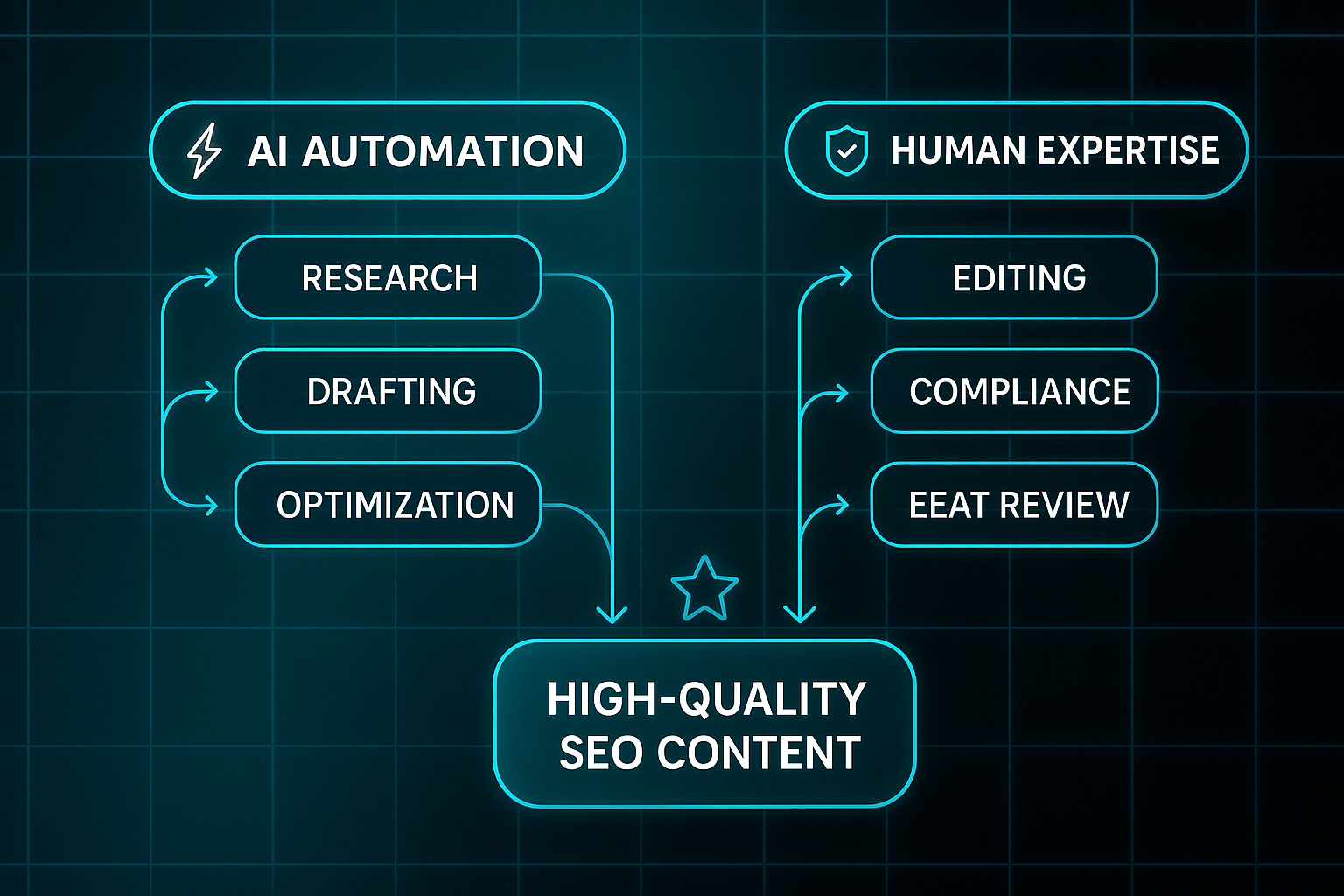
SEO is about value, not just keywords
Think keyword stuffing can still win the day? It can’t. Modern SEO is about unique insight and genuine value, not gaming algorithms. Brands prioritising editorial quality consistently see improved rankings and loyalty.
Actionable best practices for working with AI and SEO content software
Want better results? Let AI help with research and drafts, but keep humans in for editing and brand voice. Focus on expert advice, user needs, and regular SEO reviews to maintain healthy rankings over time.
Integrating SEO content writing software: Workflows, analytics, and maintenance
Workflow and publishing integration
Let’s look at what actually changes when SEO content writing software powers your workflow. Suddenly, every stage—from initial idea to publication—flows much more smoothly.
No more drowning in spreadsheets or endless emails. With built-in content calendars, automated briefs, and direct competitor analysis, teams can focus less on manual research and more on the creative side.
Platforms like Surfer SEO and Frase serve up live topic recommendations and keyword suggestions as you write. It’s almost like having search trends updated in real time, so your drafts always hit the mark.
Collaboration gets easier too. Real-time commenting, shared editing, and version control keep editors, writers, and strategists completely in sync, with feedback happening in one spot.
When it comes time to publish, that’s streamlined as well. Features like auto-generated meta tags, schema markup, and internal linking help prevent on-page SEO errors. And with direct CMS integration—or a “blog-in-one-minute” tool that spins up a site with just two lines of code—content goes live much faster.
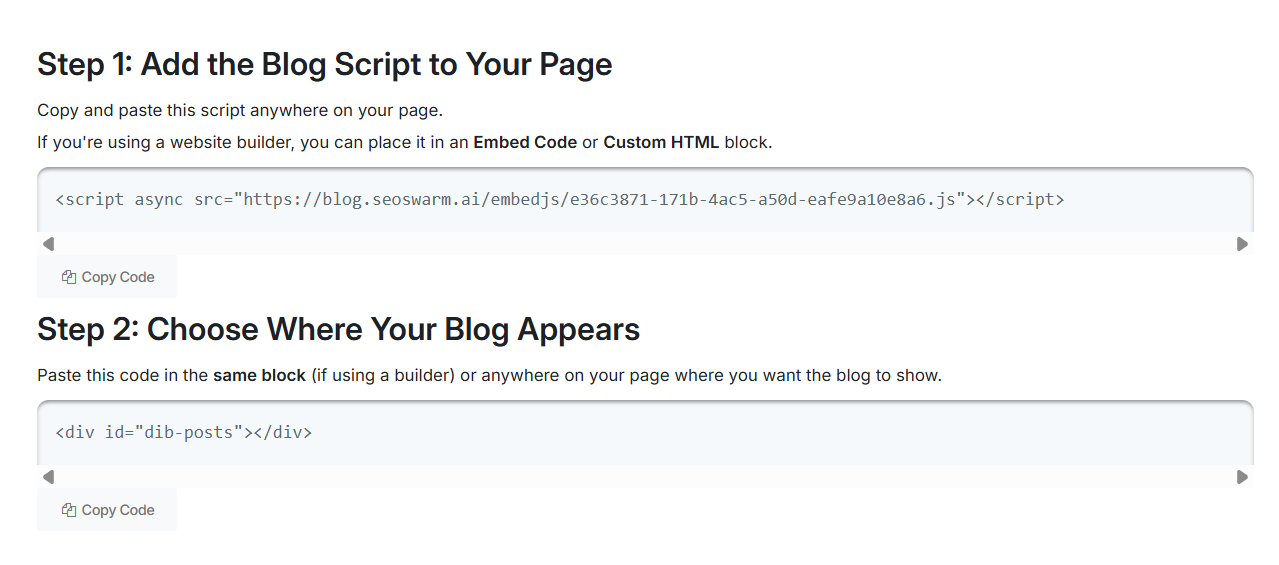
Analytics and ongoing SEO maintenance
What about after publishing? That’s where analytics dashboards come in. These often tap into Google Analytics and Search Console, letting you watch rankings, traffic, and engagement in real time.
You’ll get instant alerts if a ranking drops, a link breaks, or a technical issue pops up. Automated content audits quickly flag posts needing a keyword update or link refresh, so your content keeps up with shifting algorithms.
Standardised templates and playbooks make it easier to run consistent quality checks, even across multiple brands or projects. And with solutions like SEMrush or SEOSwarm, those reviews and updates can be handled for you with hardly any manual effort.
Effective analytics and maintenance workflows keep your content resilient—even as algorithms and search trends shift—so your SEO performance stands strong for the long haul.
Cost, ROI, and the value of SEO content writing software
Understanding pricing models and ROI measurement
When you’re budgeting for SEO content writing software, you’ll usually see three main approaches. First, there’s the subscription SaaS model—think Surfer SEO or Semrush—which charges a monthly fee, usually between £30 and £250.

Source: semrush.com
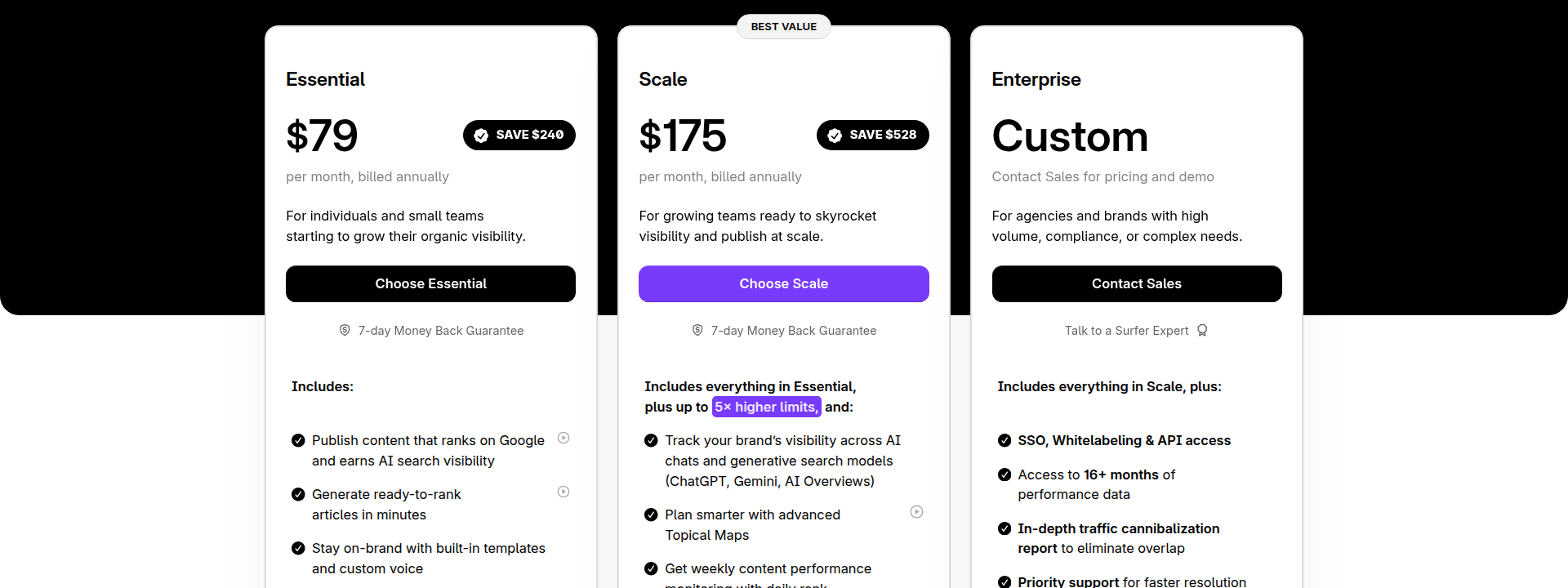
Source: surferseo.com
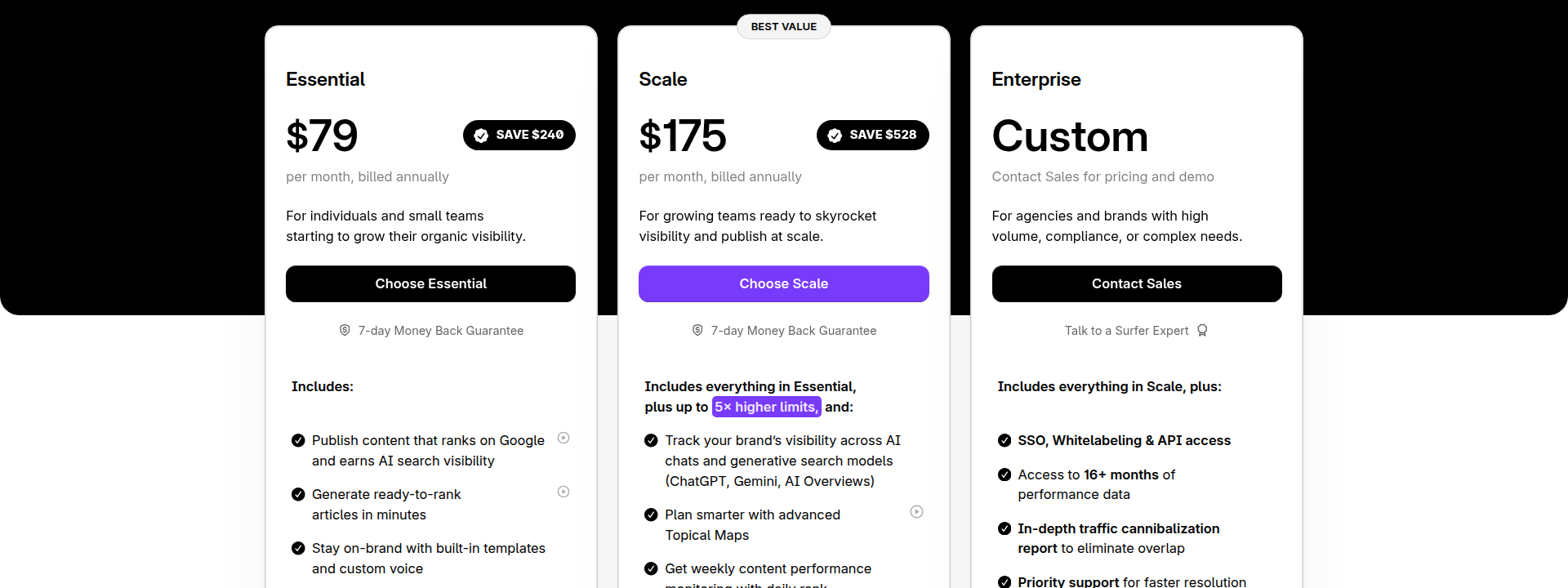
Source: surferseo.com
This route is popular for teams who like to manage everything in-house. It’s affordable, flexible, and you can scale up or down with ease.
If you want to hand things off, there are managed services like SEOSwarm. Here, you’re paying a monthly retainer—generally from a few hundred pounds upwards—so a team of agency experts runs your content game, from strategy to execution. That suits brands wanting higher scale or top-tier quality without lifting a finger.
The third option? Project-based pricing, where you pay per deliverable (typically £50–£600 per post). This fits short-term campaigns or one-off pushes, though you lose some ongoing momentum that comes with a partnership.
- Subscription SaaS
Low monthly fees; perfect for in-house control and speedy delivery. - Managed Service / Agency-Led
Pay by retainer for expert execution—spot-on for volume and quality. - Project-Based
One-time fee per piece; handy for special campaigns or occasional needs.
Tracking ROI is all about what matters most: organic traffic, rankings, and quality leads. SaaS platforms often help teams publish two or even three times more, pushing up traffic by as much as 32% within half a year.
By using AI to scale content production, Airmason generated over 200 articles, grew daily clicks by 17x, and achieved a 1300% increase in organic traffic within seven months.
Managed services like SEOSwarm? They can double your content output and leads, trimming more than 30% of manual effort for your team.
Value beyond cost: operational impact
Here’s the thing—these solutions aren’t just about what you spend. The real payoff is in the way they let you scale, automate, and keep results coming in, all while reducing stress and bottlenecks for your team.
Pick a model that fits your resources and targets, and you’ll see ongoing SEO growth that’s both sustainable and measurable. Isn’t that what everyone’s after?
Future trends in SEO content writing software
What’s next: Innovations and evolving best practices
Curious where SEO content writing software is heading? The future is about automation, more integrated workflows, and platforms combining AI with expert oversight. These tools now guide content through the full SEO lifecycle—from the first idea to live optimisation and scheduled refreshes.
Automation across the entire content lifecycle
Modern platforms like Surfer SEO and Semrush now automate outlining, scheduling, and monitor rankings—prompting updates if content starts to slip.
When Google’s algorithms shift, AI-powered rewrites can respond quickly—protecting your traffic from sudden drops.
The rise of hybrid agency + AI models
Hybrids such as SEOSwarm bring together smart AI for research, writing, and optimisation, overseen by human specialists for strategy and quality.
This mix is crucial for sectors where authority and trust can’t be compromised—think healthcare or finance.
Integrated workflow and analytics enhancements
Integrating with your CMS and analytics means less time switching tools. Surfer SEO’s Google Docs prompts and instant publishing streamline collaboration and sign-off.
Continuous content maintenance and proactive optimisation
Proactive audits and rewrite suggestions come as standard. Platforms like SEOSwarm and Semrush keep high-value pages ranking, prompting you to update as search trends change.
Sophisticated ROI and performance measurement
Today’s analytics track far more than rankings—they follow engagement, conversions, and even revenue by page. SEO decisions finally become driven by results, not guesswork.
Leaning into these next-gen advances helps brands keep pace—and secures future growth through measurable ROI and ongoing optimisation.
Making SEO Content Writing Software Work for You
Most marketers underestimate just how much time and opportunity slip away in a fragmented content workflow. The right SEO content writing software doesn’t just save hours—it turns your entire process into a measurable growth engine.
Here’s my advice: map your biggest workflow headaches, then shortlist platforms that solve those exact pain points. Run a real-world pilot, involve your editors, and don’t be afraid to blend AI automation with human oversight for the best results. If you want hands-off scale, agency-led solutions like SEOSwarm take the pressure off entirely.
SEO content success isn’t about chasing the latest tool—it’s about building a system that adapts, improves, and keeps your brand visible as search evolves. The smartest marketers don’t just write for rankings; they build workflows that keep delivering, long after the first draft goes live.
- Wil