
SEO used to mean endless manual tweaks and chasing after every new algorithm update. Now, AI agents are changing the game by handling optimisation tasks automatically and around the clock.
I've seen how these autonomous tools not only spot issues but actually fix them—whether it's technical audits, content updates, or rolling out schema markup. For anyone tired of repetitive SEO chores, this shift is a huge relief.
In this article, I'll break down exactly what SEO AI agents are, how they work behind the scenes, and the real benefits they deliver. You'll get a clear look at their core features, see how they compare to traditional tools, and find out which platforms lead the pack in 2024.
I'll also share practical examples, highlight common pitfalls, and offer tips for choosing and implementing the right agent for your needs. By the end, you'll know if this technology is a fit for your business—and how to get the most from it.
What is an SEO AI agent?
SEO has changed dramatically. Where optimising your site once meant trawling through reports and making manual updates, now AI agents are stepping up—they don’t just suggest improvements, they take action straight away.
Definition and autonomous nature
What exactly does that mean? An SEO AI agent is autonomous software powered by artificial intelligence and machine learning, purpose-built for search optimisation. Unlike the old-school dashboards and to-do lists, these agents scan your site, monitor search performance, spot new trends, and then actually implement improvements—independently.
Tasks include technical audits, updating on-page content, fixing those inevitable 404 errors, optimising internal links, or rolling out schema markup. Here’s the essential difference: autonomy. Standard SEO tools give you recommendations; it’s your job to change the site. AI agents handle that work themselves—think Alli AI instantly fixing technical issues, or Surfer AI keeping content fresh without user intervention.
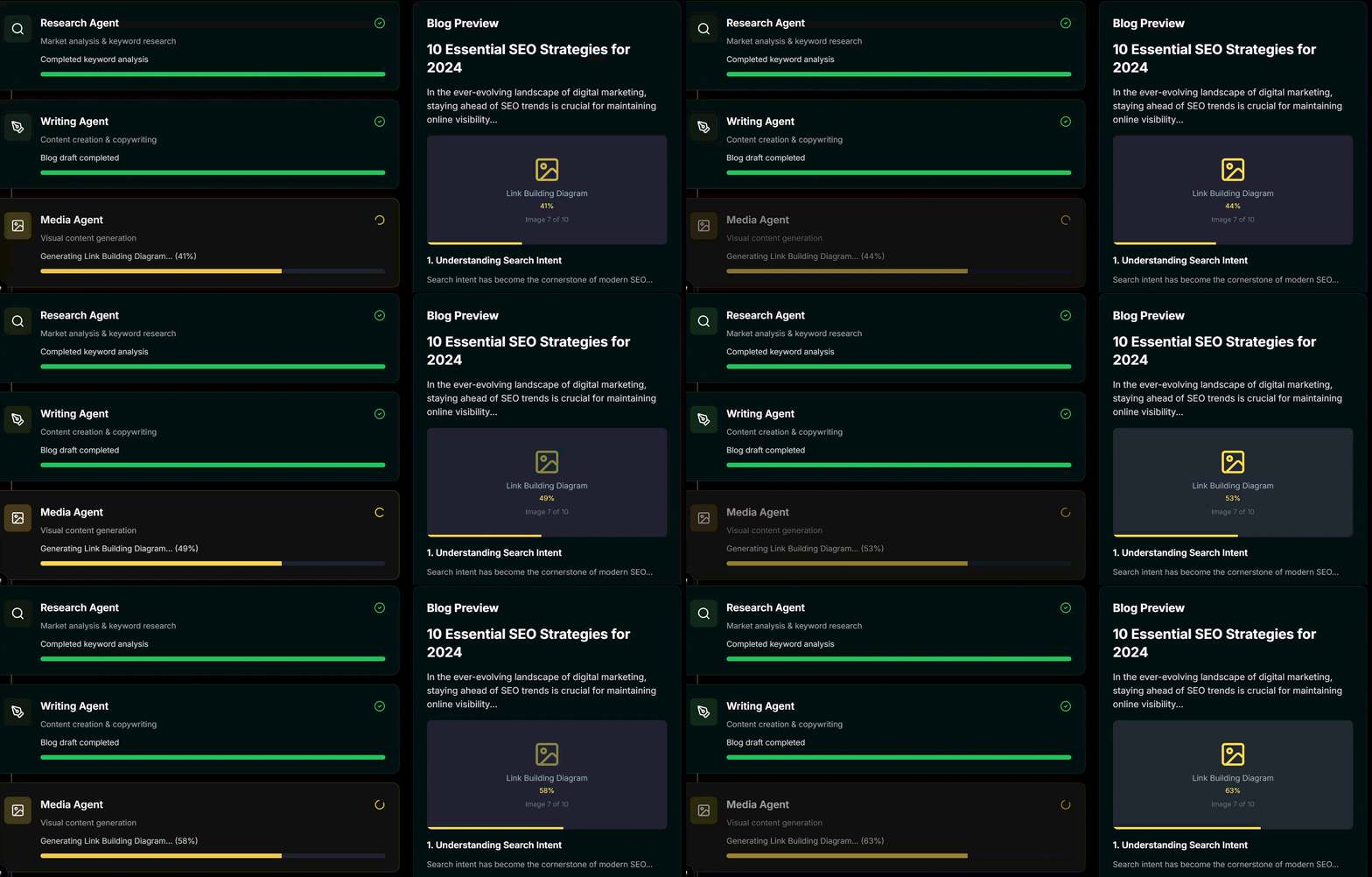
Platforms like SEOSwarm take things further with a team approach—one agent handles keyword research, another writes and edits content, while a human expert reviews it all before publication.
Want to know if the hype is real? In 2024, Surfer AI’s average user enjoyed a 205% boost in organic traffic thanks to agent-led optimisation. Alli AI’s “no-code” schema capability delivered instant, site-wide structured data. Ecommerce brands who adopted this technology cut their manual SEO work in half within six months.
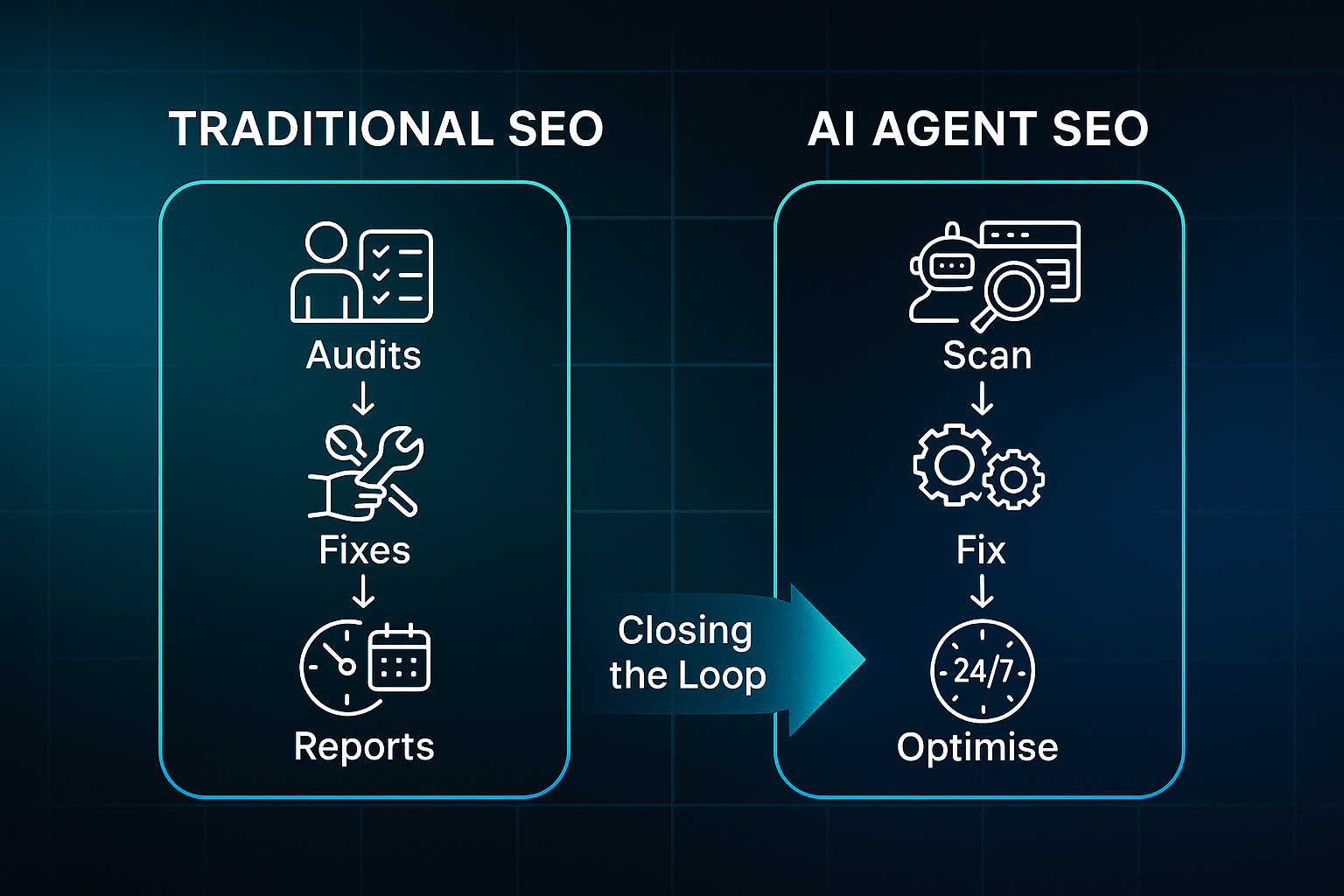
The big advantage? These agents “close the loop.” Rather than waiting for monthly reports or manually keeping up with algorithm changes, your optimisation runs around the clock and reacts the moment something shifts.
Core characteristics
What makes SEO AI agents different? These qualities stand out:
- Independent analysis
Agents spot problems—like a sudden surge in 404s—without any manual prompting. - Autonomous decision-making
They see where changes are needed (like metadata) and just do it, based on live data. - Direct action implementation
Updates and technical fixes go live site-wide, automatically and instantly. - Continuous monitoring and adaptability
Agents constantly track changes, reacting swiftly to new search algorithms. - Multi-agent orchestration
Platforms like SEOSwarm use “teams” of agents for research, content, and technical updates, working together for bigger impact.
Bottom line: adopting SEO AI agents can cut manual work by up to 50%, boost quality, and help you adapt fast to whatever search engines throw your way.
In a case study, enterprise AI platform Lyzr.ai used an AI-powered SEO tool to increase organic traffic by 150% and achieve a nearly 200% increase in impressions within just three months.
How do SEO AI agents work?
SEO AI agents operate through machine learning (ML), natural language processing (NLP), and powerful large language models (LLMs). This trio transforms manual SEO into an autonomous, responsive process that works in the background.
Technical foundations
ML algorithms digest thousands of ranking signals, user behaviours, and trend data. They spot sluggish page speeds, random 404s, and pinpoint how these affect your rankings. The agent then swoops in, fixing core issues fast—no prompt needed.
LLMs, like those built into Jasper or SEO.ai, quickly generate SEO-optimised content, well-matched headlines, and meta descriptions that align with live search intent. As trends evolve, your content can stay flexible, keeping up as search behaviour shifts.
How to Write Blog Posts Fast with Jasper AI (Step-by-Step SEO Tutorial)
NLP gives agents a semantic edge. Surfer AI, for example, analyses both your site and top competitors, flagging missing supporting keywords or key content structure gaps. This makes your site more thorough and competitive without hours of manual research.
‘No-code’ tools, such as Alli AI’s schema mark-up, remove barriers for non-coders. Advanced automation and sitewide schema updates become accessible to anyone, unlocking instant improvements with simple clicks.

Source: alliai.com
SEOSwarm brings in modular agent teams: technical, link, and content specialists each work in parallel, then coordinate changes for full-site optimisation.
Typical workflow
- Automated data collection & audits
Agents scan your site for technical and SEO issues continuously. - AI insight generation
Models flag errors, pinpoint gaps, and spot keyword opportunities. - Automated task execution
Content, fixes, and mark-up updates are created automatically. - Autonomous implementation
Updates go live or are sent for quick review. - Continuous optimisation
Agents monitor algorithm shifts, reacting instantly. - Team-based orchestration
Specialists work together, driving sitewide improvements rapidly.
The upshot? SEO AI agents deliver expert-level optimisation and adapt on the fly, keeping your website ahead of constant search engine changes—with barely any manual input required.
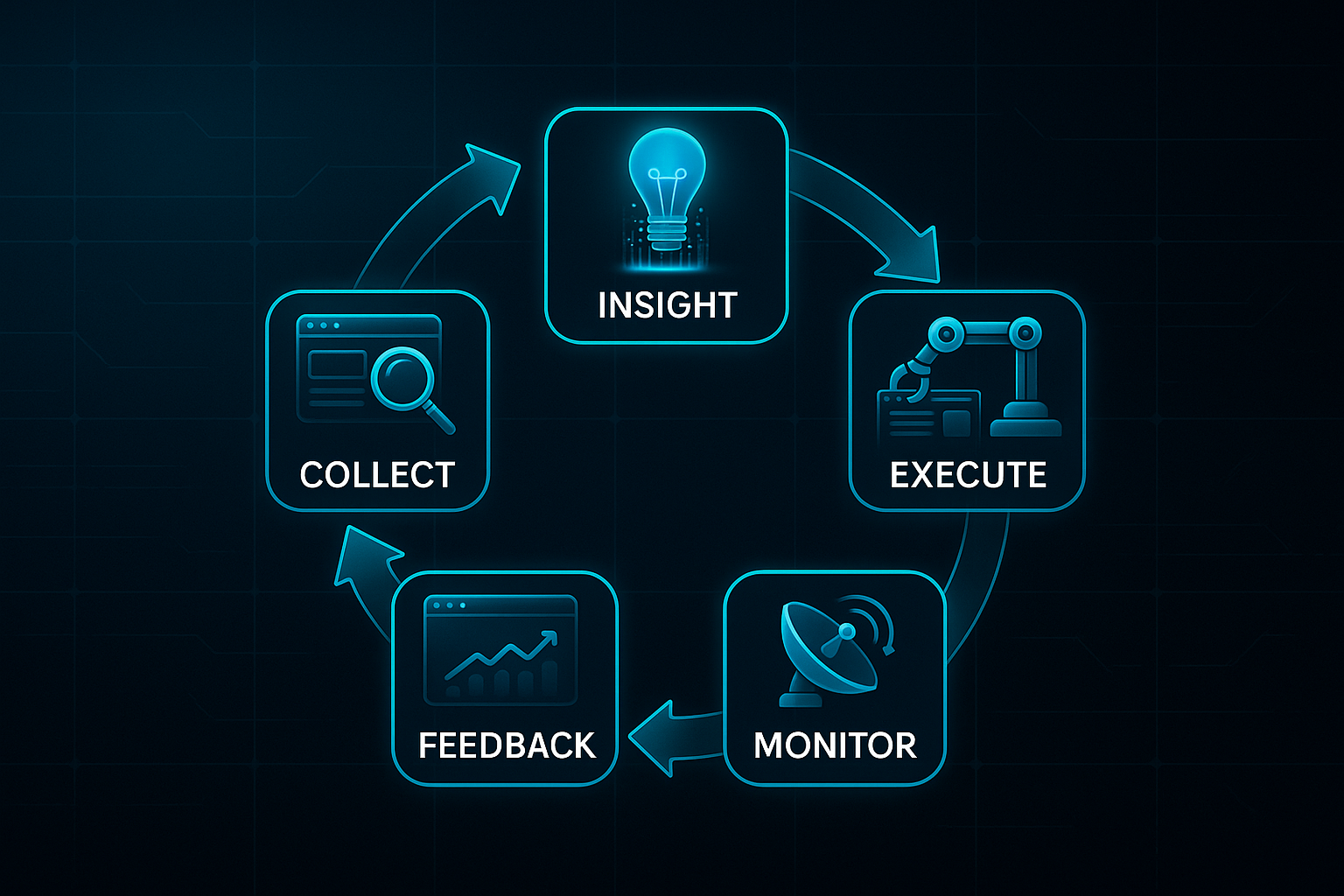
Core functions and capabilities of SEO AI agents
Automated audits and analysis
Let’s start with a big game-changer: SEO AI agents enable always-on site monitoring. Forget manual checks—these agents watch your website round the clock, scanning for everything from broken links and duplicate meta descriptions to thin content and Core Web Vitals failures.
Think about Alli AI’s massive audit feature. It’s honestly remarkable—flagging thousands of issues across sprawling ecommerce sites, sometimes more than 50,000 pages, in under a day. And they don’t just look at what’s broken; these agents highlight content gaps too. They benchmark your site against competitors and trends, picking out missed opportunities and underused keywords. Surfer AI, for example, helped SaaS providers uncover neglected articles and hidden keyword clusters, cutting manual research time by 60%.
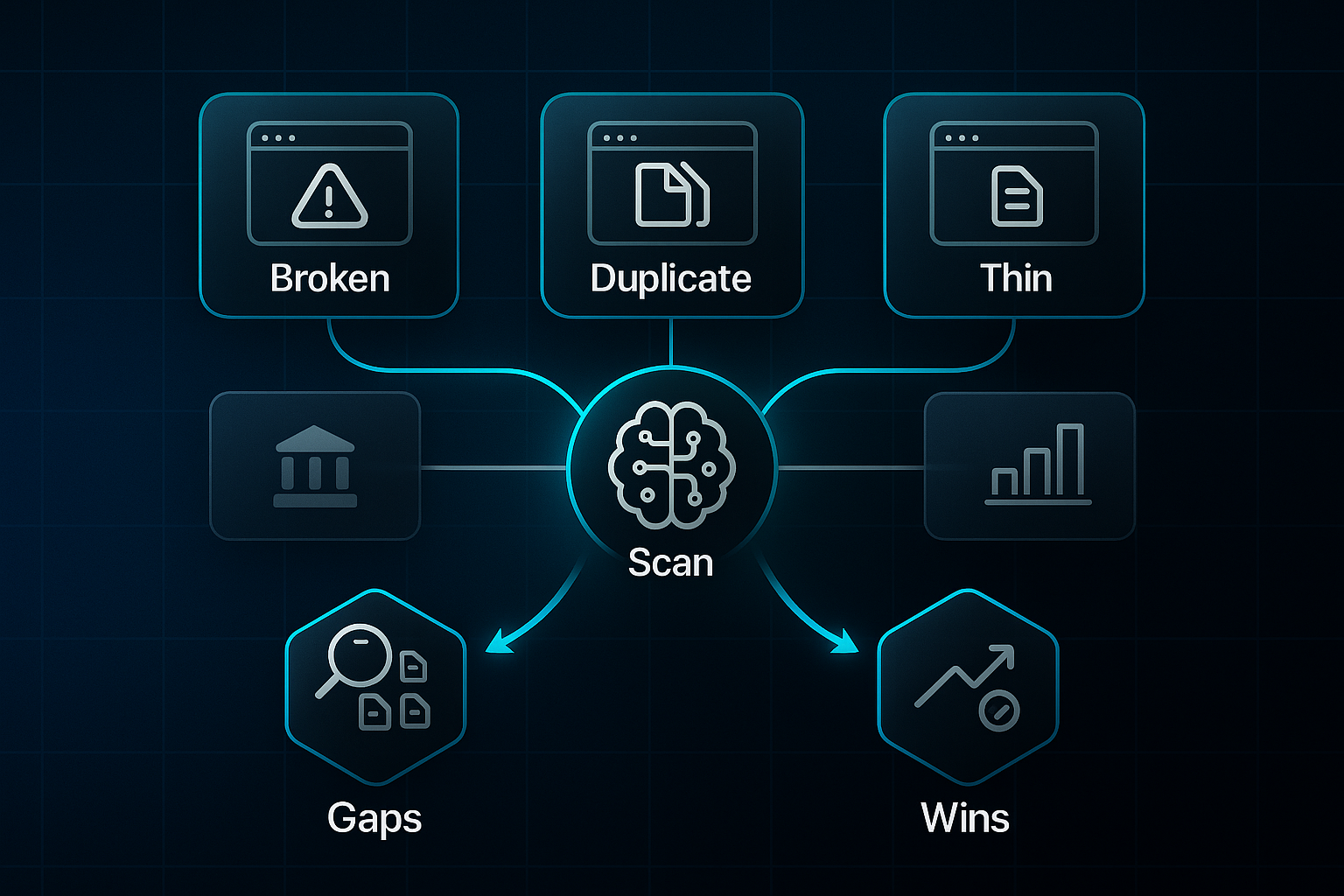
Optimisation and implementation
But here’s where things really get interesting—these agents don’t just diagnose; they fix problems on their own. The result? Less waiting, more doing. They handle bulk meta tag management, live rewriting thousands of titles and descriptions in line with current search behaviour.
When a retail client let Alli AI take over meta updates, they saw a 19% increase in click-through rates almost immediately. Internal link structure also gets a major upgrade, with agents using NLP-powered anchor optimisation, fixing broken links, and even reshaping navigation across your site. Surfer AI users, after running contextual interlinking, enjoyed up to an 18% drop in bounce rate. And for structured data? Agents roll out or patch schema markup at scale. SEOSwarm once resolved widespread schema errors for fintech clients, improving mobile usability—and making those sites eligible for rich results.
Competitor and SERP analysis
Now, it’s not just about your website. SEO AI agents are like scouts—constantly monitoring competitors and live SERPs. They track shifting rankings, spot new content, and adapt benchmarking targets on the fly.
SEOSwarm’s agents helped B2B companies grow featured snippet wins by 32% in a single quarter through agile keyword targeting. Agents pick up on trending topics or fresh gaps before rivals do—so you can move first every time.
Performance tracking and adaptation
What really sets these agents apart is their ability to keep learning. Integrated with Google Search Console, they track organic performance in real time and flag anomalies before anyone else notices. Thanks to a built-in feedback loop, every action feeds future improvements.
SEOSwarm, for example, automatically recalibrates priorities when competitors shift or algorithms update—ensuring your SEO strategy is always current and hands-off.
Blend together non-stop audits, autonomous fixes, smart competitor watching, and ongoing learning, and you get rapid, scalable SEO with less manual grind—and much better results.

AI-Powered
SEO Content Strategy
See the AI platform that's replacing entire content teams
(with better results).

What are the primary benefits of using SEO AI agents?
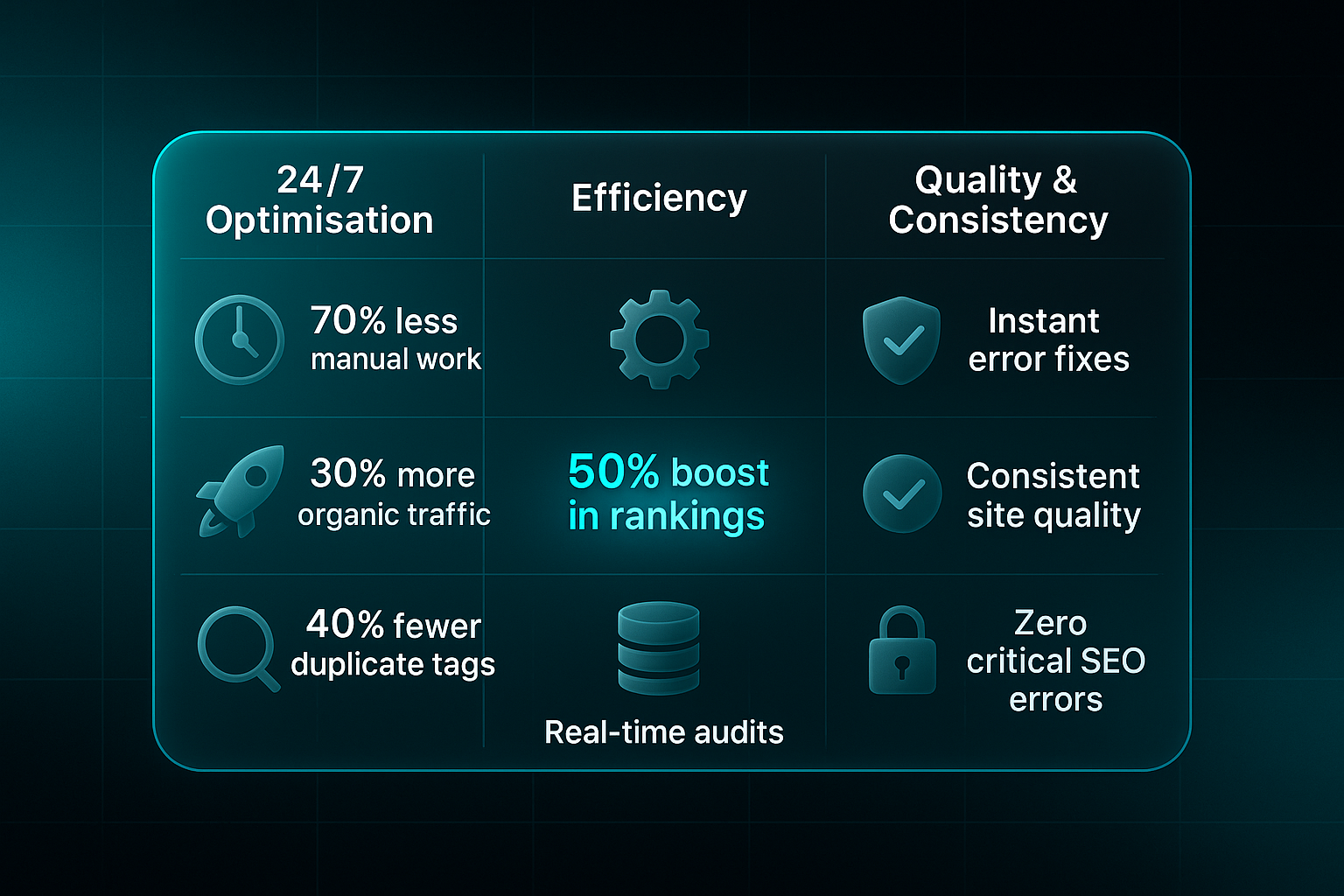
24/7 optimisation and scalability
Picture SEO experts who never rest—SEO AI agents really offer continuous optimisation, tirelessly working in the background. They react instantly to algorithm updates and competitor moves, keeping your site up to speed day or night.
Large publishers like Hearst Magazines put these agents to work for meta and schema updates, rolling out changes on 100,000+ pages in just hours, not weeks. For sprawling ecommerce platforms, agents tackle massive technical fixes, metadata rewrites, and keyword updates for tens of thousands of listings—sometimes overnight. The result? Consistent reach, no need for waves of new hires.
Take SEOSwarm’s agent orchestration: technical, content, and link agents each do their job in parallel, so publishers can optimise hundreds of properties or launch new projects quickly—with the same core team.
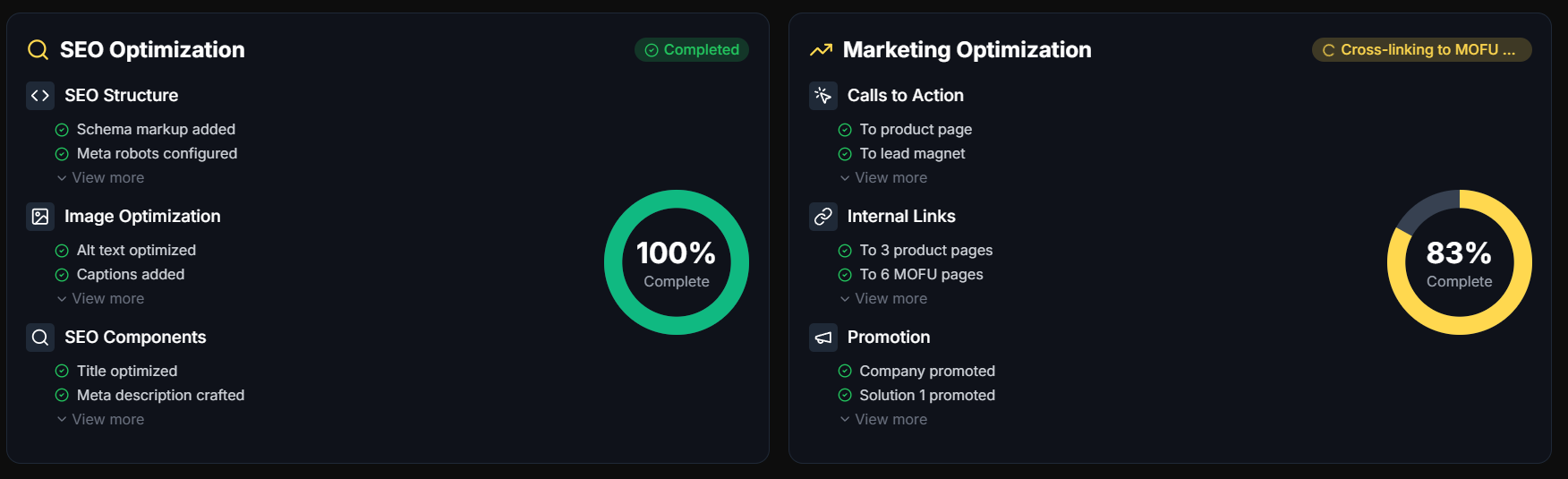
Efficiency and cost-effectiveness
Here's where agents really shake things up: automation slashes repetitive tasks—think keyword research, technical audits, metadata tweaks, schema markup, and link fixes—so human teams can put their energy into bigger, strategic work.
The impact is immediate. Leading ecommerce and publishing groups have seen the manual workload drop by up to 70% after letting agents handle background tasks. That often leads straight to a 30% jump in organic traffic post-optimisation.
In one case study, an e-commerce website automated the optimization of over 10,000 product pages using Alli AI, which resulted in a 150% increase in organic traffic and a 75% increase in organic revenue in the first year.
Editorial hours devoted to duplicate content and metadata? Down by as much as 40%. SEOSwarm’s agency clients often halve regular SEO staffing, yet roll out more content and new verticals faster, trimming costs and speeding up ROI.
Quality and consistency
AI agents are relentless about SEO best practice. Every update enforces site-wide standards, from structured data and keyword use to well-crafted internal linking.
Hearst Magazines eliminated duplicate tags and now catches errors instantly for consistent quality. Zalando used agents on their multi-lingual product pages, scaling checks to millions of SKUs, and earned a 50% boost in first-page rankings.
The agent advantage? They flag and fix broken links or uncrawled pages the moment issues pop up—well before rankings or site experience suffers. Manual teams just can’t match that level of watchfulness.
So these benefits—round-the-clock SEO, higher efficiency, bulletproof quality—all flow directly from the agent tech and workflows we’ve covered. More organisations are discovering reliable, scalable, high-quality SEO is at last within easy reach, fully ready for today’s ever-moving digital world.
How do SEO AI agents differ from traditional SEO tools?
Level of automation and autonomy
Here’s the big shift: traditional SEO tools like SEMrush and Ahrefs give you audits and action lists, but you’re stuck with the manual labour. Chasing 404 errors, editing spreadsheets, always chasing after developers—it’s still a hands-on job.
Enter SEO AI agents like Alli AI, Surfer AI, and SEOSwarm. These don’t just identify issues; they autonomously resolve them. Alli AI, for example, can boost site speed or push schema updates across your entire site with no manual lifts. Surfer AI drafts, optimises, and even publishes new content in real time, keeping pace with live trends. That means your team gets to focus on actual strategy rather than endless fixes.
So rather than dealing with constant handoffs, the agent “set and optimise” model places automatic audits, metadata improvements, and on-page updates on autopilot. You’re left free to think bigger.
Workflow and integration
Ever spent too long exporting reports or waiting on a developer? That’s the pain of a fragmented, old-school workflow.
AI agents change all that—connecting straight into tools like WordPress and Google Analytics. SEO.ai might optimise thousands of pages in hours rather than weeks. With SEOSwarm, technical, content, and research updates all happen in synchronised, unified campaigns, overseen by a supervisor for quality.
As a result, agencies and publishers deploy large-scale changes rapidly, run bold campaigns with smaller teams, and eliminate habitual friction.
Continuous learning and adaptation
This is where things get clever: continuous adaptation. Traditional tools only spot problems during scheduled reviews, leaving you scrambling when algorithms shift.
SEO AI agents track live data and adjust on the fly. When Google’s March 2024 core update landed, SEOSwarm and Surfer AI recalibrated sites within hours, maintaining rankings through real-time execution.
| Aspect | Traditional SEO Tools | SEO AI Agents |
|---|---|---|
| Automation | Manual recommendations | Autonomous, real-time execution |
| Workflow | Fragmented, delayed action | Unified, integrated, continuous |
| Learning | Periodic review | Ongoing, adaptive |
| Scalability | Manual resource limitations | Sitewide rapid changes |
| Human Involvement | High—execution required | Low—strategy and review only |
Switching to agents means no more technical firefighting—just bigger impact, faster results, and scalable strategy without extra staff.
Key features and differentiators to look for in an SEO AI agent
Core automation scope
Here’s what sets a true SEO AI agent apart: end-to-end automation. These tools don’t just offer to-do lists—they actually fix technical, on-page, and off-page SEO problems for you.
Alli AI’s 2024 update, for example, rolls out technical audits, repairs site speed issues, fixes broken links, and manages metadata across 100,000+ URLs at once. Surfer AI leverages live SERP data, constantly refining content in line with current ranking factors. With SEOSwarm, content research, writing, formatting, and instant publication are all automated by coordinated “agent teams,” making large-scale rollouts straightforward.
Source: alliai.com
And the results aren’t small. Sites using these solutions typically see 37% fewer manual hours spent on repetitive SEO tasks. Agents with predictive analytics and automated SERP monitoring—like those in SEO.ai—spot content trends ahead of rivals, which can be a real game changer.
Quality assurance and human oversight
But should you trust automation without limits? The best platforms don’t. They keep structured human review built in for safety and nuance. Jasper invites editors to approve every AI draft before it’s published. Surfer AI gives you manual signoff on changes, protecting your brand’s tone and credibility.
Alli AI’s version control lets you roll back any unwanted edits in seconds. SEOSwarm enforces SEO expert review on all outputs, so nothing slips through—this matters even more in regulated sectors or for agencies juggling several brands.
Integration and compatibility
Seamless integration is non-negotiable. Alli AI, Surfer AI, and SEOSwarm sync directly with WordPress, Shopify, Google Search Console, and Analytics—automatically updating performance data. SEOSwarm even pairs blog publishing with fast GSC-driven indexing, speeding up search visibility.
Need more control? Alli AI and SEO.ai provide robust API access for custom workflows. Rapid onboarding and easy-to-use interfaces mean agencies have onboarded 30+ client domains to SEOSwarm in just days.
Performance monitoring and transparent reporting
So, how do you keep score? The best agents provide transparent dashboards showing rankings, site health, and every update—Alli AI and Surfer AI make this instant. SEOSwarm collects analytics across multiple sites and tracks exactly who changed what, simplifying compliance and improvement.
Predictive analytic alerts in SEO.ai give agencies a 62% reduction in reporting time and a 48% faster response to ranking shifts. Full transparency means you’re never guessing about what’s working.
Put it all together—automation, oversight, seamless integration, and proactive monitoring—and you’ve got an SEO partner that genuinely moves the needle while keeping things simple.
Leading SEO AI agent solutions in 2024: SEOSwarm, Alli AI, SEO.ai, Surfer AI, Jasper, and more
SEOSwarm by Precision AI Marketing
If you’re looking for an agency-led, AI-powered SEO platform, SEOSwarm stands apart in 2024. This solution blends automation with human oversight—a team of AI agents handles everything: research, content generation, optimisation, technical fixes and ongoing improvements.
Here’s what makes SEOSwarm different. Each major update—whether it’s a new strategy, technical change, or fresh content—must be reviewed and signed off by a real SEO expert from Precision AI Marketing. For businesses in regulated sectors, that level of human intervention offers true peace of mind and contextual accuracy.
SEOSwarm highlights
- Agency-led hybrid model
Specialised AI teams tackle core SEO tasks, with expert SEO review at every critical stage. - End-to-end automation with quality control
Research, writing, publishing and optimisation are automated—every deliverable gets a final check by an SEO professional. - EEAT, analytics, and compliance by default
Built-in expertise, analytics tracking, and support for regulated industries. - Unique 'blog-in-one-minute' capability
An add-on creates entire, SEO-optimised blog hubs in moments using just two lines of code. Sold separately from standard SEOSwarm. - Best fit scenarios
Perfect for organisations needing detailed oversight, deep analytics, and high-scale SEO without expanding their team.
Alternative SaaS-based providers
Sometimes you need agile, self-serve automation—especially for internal marketing teams or agencies. These SaaS platforms bring speed, simplicity and focus to specific SEO areas:
- Alli AI
Delivers no-code technical optimisation, site-wide fixes and instant schema deployments. Ideal for scaling improvements on large, complex domains. - SEO.ai
Focuses on semantic keyword optimisation, automated briefs and gap detection. Suits publishers and teams that need evolving, intent-aligned output. - Surfer AI
Provides rapid audits, live SERP recommendations and internal linking boosts. Enables bulk technical and content improvements fast. - Jasper
Excels in scalable, SEO-friendly content creation—blog posts, ads, long-form—all with human approval for brand consistency.
How to choose the right platform
Choosing your ideal SEO AI agent? Match the platform to your business needs and resources. That means looking at these factors:
- Business needs and workflow
Consider if a managed solution like SEOSwarm or a DIY tool such as Alli AI or Surfer AI best fits your team’s expertise. - Priorities: oversight, speed, scale, compliance
Think about whether expert human review, rapid roll-outs or regulatory support matters most to you. - Scenarios and real use cases
What are your top jobs: technical SEO at scale, ongoing content, or balancing automation with hands-on control?
Strengths and standouts
Compare each platform’s core advantage. SEOSwarm offers an agency-led hybrid model with analytics and compliance. Alli AI is known for bulk no-code automation of technical fixes. SEO.ai drives semantic content audits. Surfer AI brings powerful SERP-driven optimisation. And Jasper shines with long-form content at scale.
So, what suits you? The right solution quickly reveals itself when you match strengths to your unique business challenges—and discover just how simple, powerful, and forward-thinking SEO can be.
Real-world applications: How SEO AI agents are used in practice
Ecommerce optimisation at scale
If you’ve ever run a large ecommerce site, you know how quickly things change. With new products coming and going, page numbers skyrocket. Manual SEO? It’s chasing your tail—impossible to keep up.
This is where SEO AI agents come in. They run automated audits non-stop, delivering instant, direct fixes so your site stays current. Alli AI made a massive impact for a global apparel retailer, prompting a 27% surge in organic sessions and a 36% drop in technical SEO labour within three months. Agents keep links fresh, repair schema markups, and update metadata as inventory shifts—optimisation that truly scales.

Alli AI Full Walkthrough Demo
- Automated site-wide updates
Fixes and enhances metadata, links, and schema across thousands of pages rapidly. - Demonstrated results
Apparel retailer gained 27% more organic sessions, plus big staff time savings post-implementation.
Agency and publisher use cases
Agencies and publishers tackling massive portfolios have a unique challenge. Manual reviews for scores of domains just aren’t feasible, which is why SEO AI agents are game-changers.
Surfer AI’s Grow Flow automates reporting, spots content gaps, and boosts internal linking across sites. SEOSwarm puts a twist on things, mixing agent-powered action with expert review. That combo helped a direct-to-consumer brand double its publishing rate and lift organic sessions 31% in half a year, all without bringing in new SEO hires. AI agents do the legwork; human experts ensure quality.

Grow Flow AI Growth Management Platform by Surfer SEO | SEO Growth Management Tool
- Portfolio-wide automation
Scans and updates multiple domains, closing gaps automatically with live reporting. - Hybrid oversight for quality
SEOSwarm helped a DTC brand double output and boost organic traffic nearly a third.
Small business and non-technical use
Think this tech is just for the big players? Not at all. Set-and-forget automation means small teams and novices can access powerful SEO without fuss. Even local businesses now get smart audits and site fixes—no specialist needed.
A UK plumbing firm saw exactly that. Agent-led SEO brought them a 39% leap in Google visibility and a 24% rise in bookings within six months. Hybrid approaches like SEOSwarm’s agent-plus-expert review give SMEs high-quality results—simply and affordably.
- Accessible automation
Small teams benefit from instant audits, improvements, and reports—no expertise required. - Tangible results
Local plumbing firm boosted visibility 39% and bookings 24% with AI agent support.
Common limitations and challenges of SEO AI agents
Risks of over-automation
Let’s talk pitfalls. Rely too much on SEO AI agents and you risk generic, formulaic content that never quite sounds like you—or completely misses your business objectives. Automated edits, like mass metadata rewrites or unexpected internal link changes, might hurt search visibility for your most important pages.
There’s also the issue of “AI hallucination.” Agents can confidently suggest or even publish plausible fixes and content that are actually off-target. This is where human oversight and regular checks are crucial—nothing beats a final review for catching costly mistakes before they’re live.
Transparency and explainability
Understanding what your AI “thinks” can be tough. Teams often struggle to justify or explain an agent’s decisions—especially if you’re facing compliance checks. Dashboards can visualise actions, but the logic behind certain recommendations often stays hidden.
This lack of clarity usually pushes non-technical teams to manually override critical steps, just in case. Thorough reporting helps, but it rarely gets rid of the black box issue entirely.
Customisation and workflow fit
Trying to make AI agents fit tricky industry standards? Not always simple. Unique approval chains, tight compliance workflows, or specialist tech stacks often force more manual input than you’d hoped. Agents without fine-tuning may overlook important brand or compliance requirements.
For regulated sectors, a miss isn’t just a nuisance—it often means extra manual fixes after the fact.
Data privacy and security
And then there’s data. AI agents process analytics, user records, and sensitive business info—so poor controls or loose integrations can open the door to risk. Rule of thumb: use minimal permissions, keep access tightly managed, and audit every integration.
With privacy and security demands always shifting, continual review and clear documentation are essential. Staying safe is a process—not a one-off job.
How to evaluate and successfully adopt an SEO AI agent
Operational and integration considerations
So, you’re looking to add an SEO AI agent to your toolset? Integration is your first checkpoint. It’s crucial that the agent connects seamlessly with your CMS and analytics platforms—think WordPress, Shopify, or Google Analytics—usually via robust plug-ins or APIs.
For anyone running on older or custom-built systems, consider a trial rollout in a limited area. Starting small means if things go off-script, it won’t disrupt your whole site.
- CMS compatibility
Confirm your agent supports your exact system and is kept up to date. - Security and compliance
Look for GDPR, CCPA adherence and top certifications like ISO 27001. - Vendor validation
Dive into docs and case studies—proof matters.
Quality control and approval processes
Automation is powerful, but you still want oversight. The key is combining agent-driven fixes for the routine stuff with human checks for strategic and sensitive moves.
SEOSwarm sets the bar with every significant update checked by a real SEO professional. For regulated industries or sprawling site portfolios, this sort of mixed control is invaluable.
- Approval workflows
Let agents handle easy wins, but send big edits to your team. - Routine checks
Schedule manual reviews, backed up by real-time dashboards for steady monitoring. - Rollback options
Always have a fast undo switch for unexpected issues.
Budget, ROI, and value
Now for the practical bit—cost. Don’t look only at monthly fees. Include platform, integration, staff training, and extras like SEOSwarm’s “blog-in-one-minute” add-on.
For SMEs, the win is in time savings and smoother days. Larger outfits should measure value by boosted automation, faster content launches, and fewer outsourcing bills.
- Total cost calculation
Sum all core and extra costs before signing up. - ROI metrics
Log time saved and organic growth post-launch. - Adoption pitfalls
Skip overlapping tools and piecemeal launches—unify your approach for the best impact.
Get these basics right, and adopting an SEO AI agent becomes a real game changer for your results.
Blog-in-one-minute
Add a fully SEO-optimised blog to your website with just 2 lines of code.
Learn more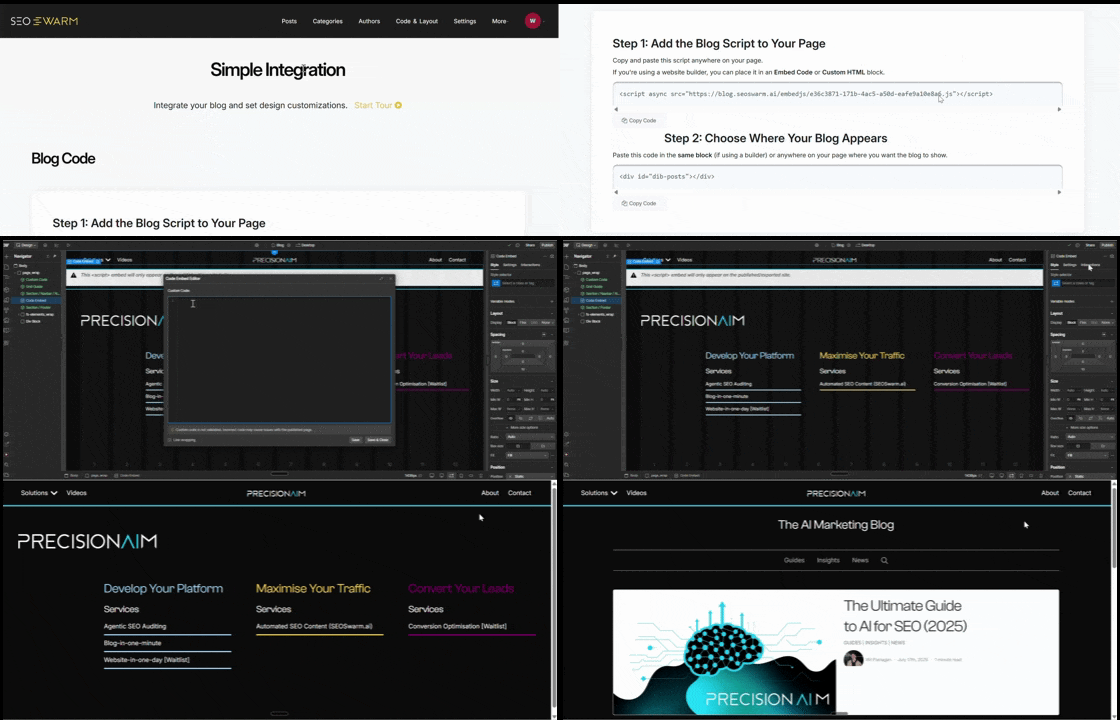
Emerging trends and the future of SEO AI agents
Hybrid human + AI workflows
Here’s a real shift—hybrid human and AI workflows are fast becoming the SEO standard. AI handles technical SEO, allowing people to zero in on strategy and branding.
Research suggests hybrid content operations, which combine AI and human efforts, help lean marketing departments by saving time and reducing costs.
Platforms like Surfer SEO, Jasper, and SEMrush manage audits and updates automatically. Specialists are increasingly fine-tuning agent workflows to fit compliance and campaign needs.
- Mainstream hybrid adoption
AI automates technical SEO, letting teams focus on creativity, brand, and strategy. - AI workflow specialists
Experts optimise workflows so agents’ output meets campaign and compliance needs.
Greater sophistication in AI-generated content
AI content creation has stepped up. Surfer SEO and MarketMuse deploy semantic optimisation and NLP to tailor content to meaning, intent, and search trends.
Small businesses now compete more easily—ranking improves measurably with smarter content that matches what users actually want.
- Semantic content optimisation
These tools align content with meaning and search intent for higher relevance and rankings. - Performance results
Businesses report noticeable ranking gains and an edge from AI-powered, semantic content.
Ongoing performance management
Performance moves to real time as agents keep sitemaps current, fix technical issues, and deliver analytics instantly—making rapid SEO adjustments easy.
- Real-time monitoring
Agents offer instant updates, cutting down manual reviews. - Automated analytics
Marketers adapt SEO fast, responding to live ranking and engagement data.
Market evolution and new directions
SEO AI agent use is surging. Leading SaaS platforms now provide advanced agent features for any business. By 2025, 58% of SEO pros expect to use AI, fuelling rapid growth.
- Broader agent ecosystem
SaaS platforms offer SEO agents and plugins to all business sizes. - Wider AI adoption
Most SEO professionals will use AI by 2025; growth is robust. - Convergence of agency and DIY models
Agencies and small businesses alike enjoy similar benefits and competitive scale.
How SEO AI Agents Change the Game
The real shift in SEO isn’t about more data or faster reports—it’s about letting smart agents do the heavy lifting, so you can focus on strategy. I’ve seen firsthand how autonomous AI agents close the loop: they monitor, fix, and optimise in real time, slashing manual work and keeping your site ahead of every algorithm change.
If you’re ready to move beyond endless checklists, here’s my advice: - Start with a trial on a low-risk section of your site to see the impact. - Choose a platform that fits your workflow—hybrid models like SEOSwarm offer both automation and expert oversight. - Set up regular reviews to catch any off-target changes and keep your brand voice intact.
SEO AI agents aren’t a magic bullet, but they are a force multiplier. The teams that combine automation with human insight will outpace those still stuck in manual mode. The future of SEO belongs to those who let machines handle the grind—and reserve their own energy for what truly moves the needle.
- Wil