

Producing SEO content at scale has never been easier, but the risks of relying solely on AI are real. Many businesses chase quick wins with automated tools, only to see their rankings drop or face Google penalties when quality slips.
I've seen firsthand how AI-generated content can help brands grow—if it's used thoughtfully. The trick is knowing where automation shines, where it falls short, and how to avoid the common traps that lead to thin, generic, or even penalized pages.
In this article, I'll break down exactly how AI-generated SEO content works, what Google expects, and the pitfalls that can tank your site. You'll get practical tips on blending AI speed with human expertise, plus clear examples of what to do—and what to avoid—so your content stays competitive and compliant.
Whether you're scaling up your blog or just curious about the latest best practices, you'll leave with a clear, actionable roadmap for using AI in SEO without sacrificing quality or trust.
What is AI-generated SEO content
Definition and key concepts
AI-generated SEO content covers written pieces—think blog posts, landing pages, and web copy—created mostly by artificial intelligence tools, all aiming to boost a site’s visibility on search engines. What sets this content apart is its computer-driven creation and a clear focus on SEO essentials: smoothly placed keywords, aligned with real search intent, and structured headings that help ranking. Importantly, this type of content is always found on public, search-indexed web pages.

Scalability is the real draw here. With AI, you can produce large volumes of optimised content at a speed traditional manual teams simply can’t match. Automated systems handle topic research and first drafts, letting sites grow rapidly and react to new trends right as they emerge.
Yet, there are clear trade-offs. Manual content creation often offers more depth and brand flavour, whereas AI favours speed but, left unchecked, can miss nuance and feel generic. That’s why oversight is crucial—you need to ensure quality, check facts, and maintain strict EEAT standards (Experience, Expertise, Authoritativeness, Trustworthiness).
Human oversight is non-negotiable for AI-generated content. An editorial review process is required to fact-check, add unique perspectives, and infuse the content with the first-hand experience necessary to satisfy E-E-A-T guidelines.
If your content doesn’t match what users are truly looking for, it simply won’t deliver results.
Which leads to the question: can automation really stand in for the human touch? We’ll revisit the importance of expert review in upcoming sections.
Why AI-generated content matters in SEO today
AI has changed the SEO landscape. Now, businesses can go after more keywords, pivot quickly to new topics, and stay on top of shifting search algorithms. Automation helps you spot and seize opportunities fast, so you’re not left chasing the competition.
But there’s another huge benefit. AI analyses shifting search trends, monitors user behaviour, and suggests new tactics at just the right moment. When search patterns or rules suddenly change, AI-generated content adapts to keep your site relevant. For brands looking to grow or just stay visible online, using AI for SEO content is practically essential—provided you enforce rigorous quality checks.
By using AI to generate and optimize blog posts for a client in the competitive SaaS industry, one agency was able to increase their organic keyword rankings by 110% in just three months.
What is excluded from this article’s focus?
Just to clarify, this article is about AI-generated, SEO-focused, search-indexed written content on public websites. We aren’t talking about:
- AI creative/human-interest writing
Stories or personal posts not designed for search engines. - Non-indexed AI documents
Internal reports or files never meant for public web search. - Non-content AI SEO applications
AI for technical SEO or analytics not tied to website content. - AI as idea generator/editor only
Instances where AI just brainstorms or polishes, not writes the main piece.
From here on, we’re keeping the spotlight on public, search-optimised AI-generated SEO content—because that’s where businesses are finding their edge.
Google’s official stance on AI-generated SEO content: What you need to know
Google’s published policy and statements
Ever wondered, does Google punish you just for using AI-generated content? The answer is simple: no, not if you focus on quality, originality, usefulness, and user value—not the authorship.
Since early 2023, Google’s documentation has confirmed that using AI for content doesn’t put a target on your back. As long as your pages prioritise genuine user intent, demonstrate E-E-A-T (Experience, Expertise, Authoritativeness, Trustworthiness), and deliver tangible value to readers, they’re fair game for search rankings.
What matters to Google is the outcome—does the page help users? The process (whether human or machine) isn’t what’s judged; it’s whether the content is truly helpful.
March 2024 update and ‘scaled content abuse’ crackdown
But in March 2024, Google drew a harder line around ‘scaled content abuse’. That means mass-churning low-value or manipulative articles—often with AI—to seize trending keyword traffic.

The update targeted sites that rapidly generated similar, thin, or near-duplicate content, often with minimal oversight. SpamBrain—Google’s anti-spam engine—flagged sudden publishing spikes, templated layouts, and repetitive structure. The result? Over 800 sites lost their place in search for falling into these traps.
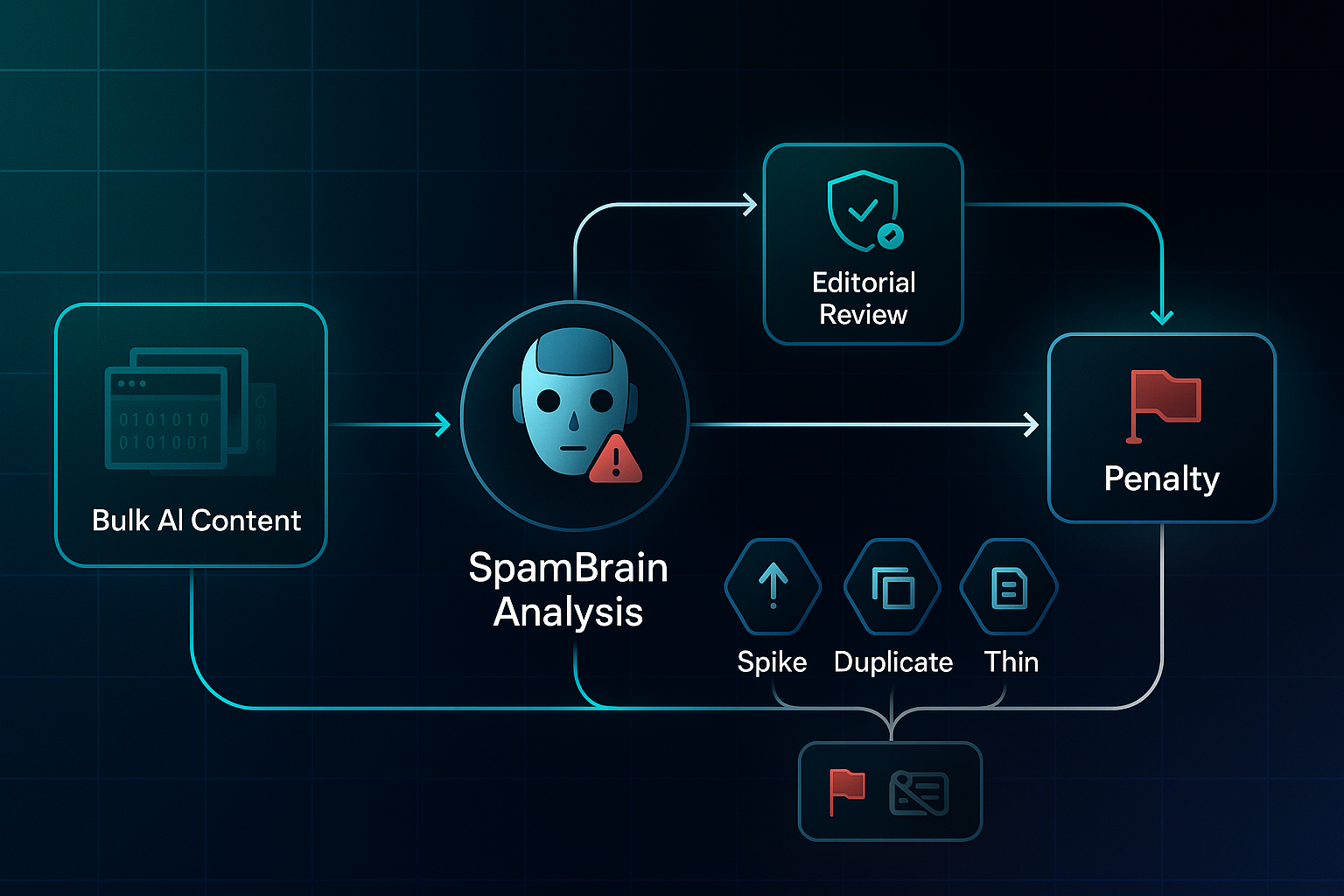
The thing is, using AI itself isn’t the issue. It’s the pattern of behaviour and overall quality that put sites at risk.
The vital role of human oversight in Google compliance
Here’s the big takeaway: human review is essential if you want to keep ranking with AI-generated SEO. Fact-checking, weeding out errors, legit brand insights, and making sure every article lines up with user needs—these steps set compliant sites apart.
Engaged human review boosts engagement and shields against Google’s penalties. And for those tough, high-stakes topics—dubbed ‘Your Money or Your Life’ (YMYL)—genuine experts are needed for compliance and rankings.
What actually triggers spam or ranking penalties?
So, what gets sites penalised? It’s mostly large-scale automated thin content, bland copy-paste jobs, exploiting expired sites, or skipping human oversight. Google flags high duplication, sudden spikes, or templated posts, resulting in warnings like ‘Pure Spam’ or ‘Scaled Content Abuse’ and a massive loss of traffic.
So, here’s your best move: let AI speed things up, but anchor every piece in strong editorial review. Focus on original, genuinely valuable, people-first content—and you’ll remain safely on Google’s good side.
When does AI-generated content work for SEO—and when does it not?
Where AI-content delivers SEO value
Let’s be honest: AI-generated content really shines with high-volume, clearly defined SEO jobs—think blog outlines, topic clusters, FAQs, product descriptions, and comparison tables. For these, it can rapidly map keywords, structure pages, and even suggest schema, all at scale.
That’s a huge advantage when you need consistent site updates or want to target a broader range of keywords without exhausting your editorial resources. Tasks like repetitive lists or basic markup? AI can handle those efficiently.
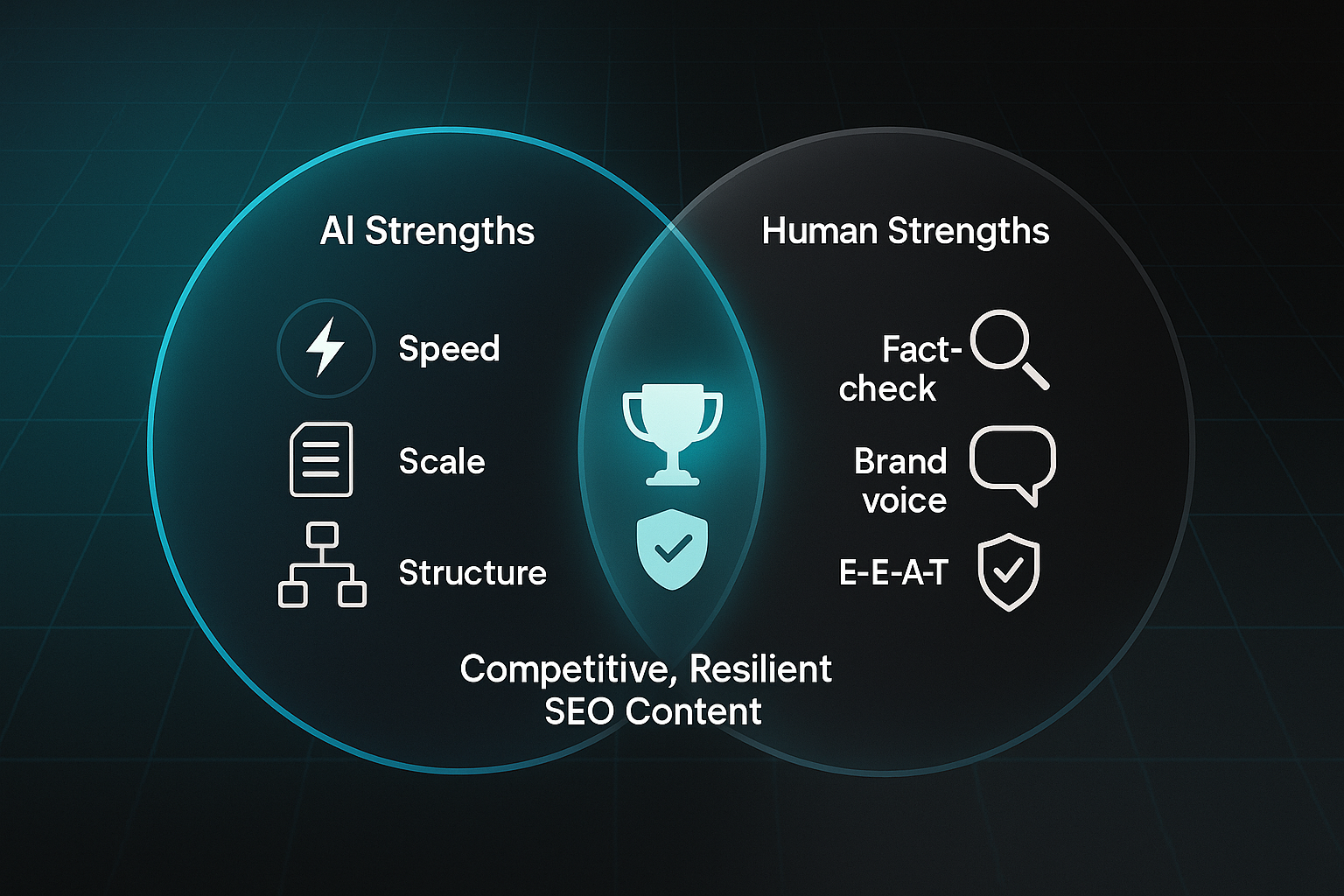
But here’s the thing—focused human review is what unlocks lasting value. Drafts must be fact-checked, polished, and shaped to the brand’s voice. That blend of machine speed and editorial skill is how top SEO teams keep content ranking—even as algorithms shift.
- Blog outlines and topic clusters
AI maps keywords and structures content for search authority. - Product descriptions
Bulk creation; requires compliance checking. - FAQs and Q&A sections
Structures answers for snippet and query relevance. - Comparison tables and lists
Automates list-style formats for query types. - Schema-enhanced content
Identifies schema opportunities for SERP features.
Relying on both automation and editorial insight helps your content stand out and stay resilient.
Clear limitations and known weaknesses
But, AI content alone hits a wall. It often lacks original insight and struggles with recent data or brand style. Automated pieces tend to be formulaic, sometimes outdated, and can leave your site at risk of “thin content” penalties if published unchecked.
Sites mass-producing such content have seen their search rankings drop as pages blend together and lose uniqueness.
- Lack of originality
Misses genuine expert and unique insights. - Inaccuracy or outdated facts
May draw from incomplete or old information. - Brand voice inconsistencies
May not match authority or tone. - Formulaic results
Prone to repetitive, non-distinct content.
The necessity of human enhancement
So, what keeps great content competitive? Human editors. They inject authentic expertise, correct facts, fine-tune the writing, and boost EEAT—all crucial for authority and compliance.
- Accuracy and fact-checking
Editorial review maintains content reliability. - E-E-A-T enrichment
Adds authentic expertise. - Brand voice refinement
Aligns message and tone. - Competitive advantage
AI+human teams consistently outperform AI-only output.
Blending automation with manual review is now the real SEO game-changer.
Best practices for AI-generated SEO content: Dos and don’ts
Hybrid human+AI content creation workflow
Creating effective AI-generated SEO content isn’t about handing over the whole process to the machines. Instead, it’s more like building a well-oiled partnership—AI sprints through the early stages, but real expertise turns drafts into remarkable, Google-friendly articles.
Think of the initial phase as AI's playground. When you hand a large language model a sharp, tailored prompt, it churns out research, outlines, and even robust keyword plans in record time. For those repetitive jobs—FAQs, product overviews, “versus” tables—AI can rapidly produce drafts that already tick most technical SEO boxes.
But, and here’s the crucial bit, even the best algorithm still needs a hands-on editor. That’s where humans come in, picking up where AI leaves off. Editors check facts with a fine-toothed comb, ensuring up-to-date stats, accurate claims, and regulatory compliance, especially for sensitive areas like health or finance.

If AI slips up or draws on outdated info, it’s the human team who catch it before it goes live.
One thing I’ve noticed? Real editors excel at turning stiff, generic language into a voice that actually reflects your brand. A computer might give you the literal meaning, but only people bring the nuance and warmth that turns information into a story—and stories build trust.
Need to weave in lived experiences, new case studies, or jaw-dropping visuals? That’s still strictly a human job.
So, how does this all tie together for SEO? Well, human input doesn’t just patch over AI gaps. It’s essential for demonstrating E-E-A-T signals—that is, genuine experience, expert authority, and earned trust—which Google rates highly.
Overlook this, and you’re risking both penalties and the dreaded drop in rankings.
And let's not forget: for regulated sectors, the stakes are even higher. One factual error in a finance article, or outdated health advice, can do more than harm rankings—it might spark legal trouble or sink your reputation.
By blending AI’s speed with rigorous editorial review, you navigate SEO, compliance, and brand building all at once. Frankly, fully automated AI just doesn’t cut it anymore.
A key risk of generative AI is its potential to produce inaccurate or misleading information, often referred to as 'hallucinations.' In the legal context, relying on such information can have severe consequences... This underscores the need for rigorous fact-checking and human oversight when using AI-generated content.
The gold standard for AI-powered SEO is a workflow where smart machines and smart people collaborate, creating fast, scalable, and truly authoritative content that stands apart—for users and for search engines.
That’s not just a smart move. It’s the new industry standard—and it’s here to stay.
Risks, pitfalls, and Google penalties: What to avoid with AI SEO content
The main dangers of careless AI content use
Careless, large-scale AI content? It’s a shortcut straight to disaster. Just look at Pixelfy.me—after Google’s March 2024 update, they lost 99.7% of their organic traffic.
How did it happen? They published swathes of unvetted, AI-written guides. One odd “flute guide” even focused on drinking glasses instead of musical instruments.
Without anyone checking, genuine value disappeared. Even after cleaning up, Google’s trust didn’t return. The penalty stuck, no matter what.
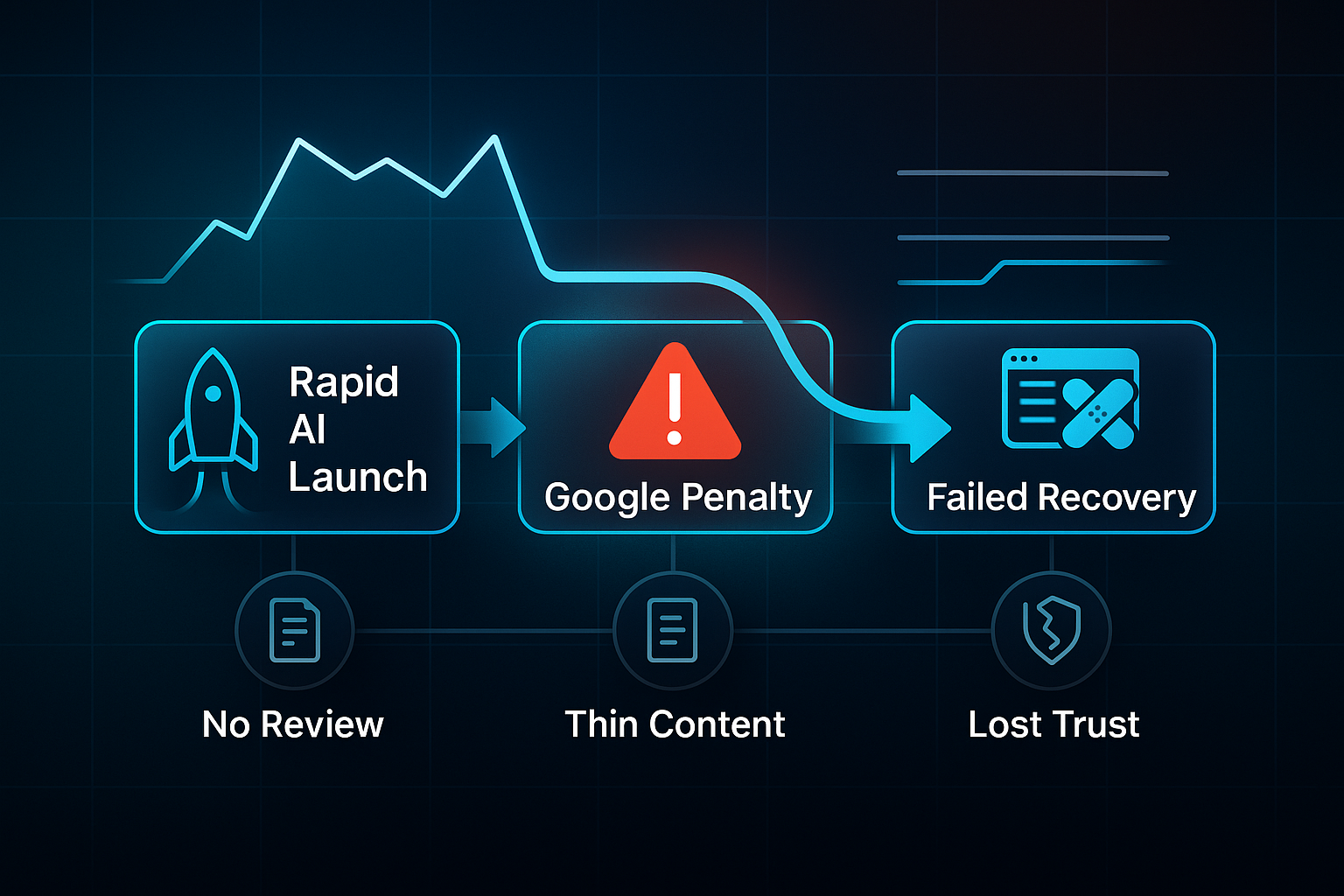
Here’s the lesson—this isn’t about using AI, it’s about recklessly scaling low-value material. Casual.App’s fate was similar. Chasing quick volume risks a lasting SEO scar.
How Google detects and penalises ‘SEO spam’
So, how does Google spot the offenders? It’s a mix of sharp algorithms and hands-on review.
Since March 2024, Google flags ‘scaled content abuse’—mass-produced, cloned, or thin articles flooding a site. This behaviour brings demotions, manual penalties, and sometimes, a total removal from Google’s index.
What else trips Google’s wires? Mass creation of similar pages, duplication, blatant keyword stuffing, and chasing rankings over readers. Warning signs? Sudden drops in traffic, Search Console alerts, and persistent ranking losses.
Here’s the tough bit—even swapping in hand-edited content doesn’t guarantee your reputation comes back.
Mitigation: How to protect your site
To sidestep these dangers, you need humans firmly in control.
Make editors rigorously fact-check every AI draft and enrich them with real insight. Show genuine Experience, Expertise, Authoritativeness, and Trustworthiness (E-E-A-T).
Frequent audits (using Google’s site:yourdomain.com search) catch hidden junk. Check Search Console for early warning signals.
Spot spikes in indexed pages, falling engagement, or nosediving traffic? Act fast. Ongoing contributor training, creative AI prompting, and updated guidelines will keep you on track.
Make these practical steps routine in your SEO playbook.
| Pitfall | Warning Sign | Safeguard |
|---|---|---|
| Scaled content abuse | Many similar, low-value pages; sudden traffic loss | Quarterly audits; enforce line-by-line human review |
| Duplication/reused templates | Near-identical layouts; Google warnings | Rotate templates; add original insights |
| Thin AI content | Short, generic output; low engagement | Fact-checking; add expert commentary; strengthen E-E-A-T |
Self-serve AI SEO tools vs managed solutions: Key differences and decision factors
Strengths and weaknesses of popular AI SEO tools
Ever wondered how so many businesses churn out fresh SEO content with such speed? That’s thanks to self-serve AI SEO tools like Jasper, Copy.ai, Surfer AI, and Writesonic.
These platforms let users generate and optimise content rapidly—no need for a massive team. Their big draws are speed and affordability; startups, ecommerce shops, and agencies value pushing out high-volume content at low cost. Picture a small retailer updating hundreds of product descriptions via Copy.ai, or an agency using Surfer AI to audit blog posts without hiring extra staff.
But there’s a trade-off. While these tools deliver scale, outputs are often generic and lack that human editorial feel. For sectors like finance or healthcare, the risks get bigger since technical content must be accurate and compliant. Even Jasper’s brand voice features don’t replace manual checks—editor review is vital to catch mistakes or outdated claims.

Skip this step and you might publish misleading or non-compliant material, risking Google penalties or reputational damage. Imagine a fintech relying solely on AI for regulated blogs, or a health site offering advice—without meticulous review, credibility is at stake.
Here’s how the main tools compare:
| Tool | Major Strengths | Key Limitations | Typical Use Case |
|---|---|---|---|
| Jasper | Brand voice customisation | Requires compliance review | Scaling enterprise blog content |
| Writesonic | SEO insights, fast generation | Needs expert editing | Agency/high-volume workflows |
| Surfer AI | On-page audits, SERP analysis | Limited brand/voice personalisation | Technical/content marketers |
| Copy.ai | Rapid basic draft creation | Weak on advanced SEO nuance | Ecommerce, quick product descriptions |
So, while these tools transform content production, genuine quality and compliance always depend on engaged, smart human oversight.
How to integrate AI-generated content responsibly in your SEO strategy
Bringing AI-generated content into your SEO workflow isn’t just about pumping out copy at lightning speed. Especially after Google’s recent crackdown on “scaled content abuse” and the tough penalties handed out in 2024, it’s clear: you need a workflow that puts human expertise front and centre if you want consistent, long-term results.
So, how do you actually combine the incredible efficiency of AI with the rigorous quality control only real people can provide? Here’s where the magic of a collaborative human+AI workflow really comes into play.
Setting up a collaborative human+AI workflow
It starts by matching jobs to the right player. AI’s strength? Rapidly generating topic ideas, clustering keywords, and spinning up first-draft outlines—perfect when you need to scale up or chase new trends quickly.
But then there’s the human side. Editors take on the critical role: fact-checking every AI draft, tweaking for brand voice, fixing awkward phrasing, and ensuring every piece lines up with what your readers and business actually need.
In sectors under tight regulation—think healthcare or finance—human reviewers also have to confirm regulatory compliance, inject real expert commentary, and make sure a qualified specialist signs off before publishing. Professional publishers often require credentialed experts for YMYL (Your Money or Your Life) content, satisfying Google’s E-E-A-T standards—Experience, Expertise, Authoritativeness, and Trustworthiness.
A robust human+AI process usually follows this rhythm:
- Ideation & keyword research
Let the AI surface new topic clusters and find keyword gaps. - Outline and draft
AI writes up an initial, structured draft. - Editorial review
Editors verify facts, refresh references, and fine-tune the tone. - Expert enrichment
Subject specialists add unique data, fresh insights, or personal commentary. - SEO & compliance check
Reviewers ensure schema is included, links work, and that regulatory boxes are ticked. - Multi-person review
For high-stakes subjects, more than one set of eyes checks for originality and compliance. - Publishing & monitoring
Once live, performance signals and compliance are tracked closely.
Editorial control over publishing is your final—and essential—safeguard. This separates resilient, people-first websites from those vulnerable to penalties and loss of trust.
In other words, a collaborative workflow isn’t just smart—it’s the foundation of any sustainable SEO-driven content strategy today.
Blog-in-one-minute
Add a fully SEO-optimised blog to your website with just 2 lines of code.
Learn more
Recent trends and the future of AI-generated SEO content
Major developments in 2023–2024
Have you noticed how Google’s Search Generative Experience (SGE) has turned traditional SEO on its head? In 2023, these AI-driven answer panels began showing up for nearly 87% of searches, sitting right above regular results. And here’s the eye-opener—just 4.5% of SGE answers match what’s on Page 1 organically. So, to appear in those coveted spots, your content needs to be smartly structured and genuinely worthwhile.
Naturally, brands rushed to keep up. They leaned heavily into AI content to stay visible under the new rules—there’s simply no ignoring SGE’s impact if you want to be found.
But with that surge came a serious reality check. Google’s March 2024 core update triggered a major clampdown on “scaled content abuse”: anyone bulk-publishing thin, repetitive AI articles, or recycling expired domains, saw their traffic nosedive—thousands of sites wiped from search overnight. It proved that human oversight and quality control have become absolute essentials, not just nice-to-haves.
And if your site handles YMYL (Your Money or Your Life) topics, expect even tougher scrutiny. Google’s demanding author credentials and real expertise everywhere—no shortcuts.
Emerging best practices and success factors
So what actually works now? The smartest teams combine fast, AI-driven drafts with rigorous, hands-on editing. Editors fact-check, bolster brand authority, and add real-world insights, while AI tracks SERP trends and supports quick updates. This partnership is what keeps brands competitive and compliant.
Future-facing strategies for marketers and SEOs
Looking ahead, marketers should optimise for answer engines—think schema markup, visible citations, and clear trust signals like author bios. Keep an eye on new AI authenticity rules and be ready to expand into video, voice, or interactive formats as they become crucial for search.
To stay relevant, hybrid workflows and credibility-building strategies are your best strategy, especially as AI and search standards keep evolving.
How SEOSwarm elevates AI-generated SEO content: Quality, scale, and continuous optimisation
The SEOSwarm difference: Human expertise plus agentic automation
So, what really sets SEOSwarm apart? It’s their seamless fusion of AI-powered automation with expert human oversight.
Rather than letting algorithms run unsupervised, SEOSwarm’s workflow relies on smart AI for research and drafting, with experienced editors involved throughout. This partnership ensures content hits high SEO standards—never sacrificing quality for speed.
- Managed hybrid workflow
AI and editors closely collaborate, keeping output fast but always rigorous. - AI-driven optimisation + human trust signals
AI nails keywords and schema; editors reinforce E-E-A-T and authentic brand tone. - Unique, authoritative content by default
Every article reflects Google’s Experience, Expertise, Authoritativeness, and Trustworthiness through hands-on editorial review.
Key benefits over standalone AI tools and traditional agencies
Ever walked away from a quick AI tool with generic content? Or run the numbers on agency fees for big projects? SEOSwarm bridges these extremes by pairing automations with engaged editorial review to deliver both substance and speed.
- Automatic technical and trust optimisation
Schema, internal links, and trust signals built into every post—no missed essentials. - Continuous improvement and monitoring
Analytics and blog tune-ups keep your rankings current as search trends evolve. - Direct publishing and faster indexing
SEOSwarm posts publish straight to your site and leverage integration for rapid indexing. - High-quality scaling at lower cost
Scale widely with AI, but maintain editorial standards—at a lower cost than most agencies.
How blog-in-one-minute works as an add-on integration
Need a blog live right now? The blog-in-one-minute feature has you covered.
- Instantly deploy a full SEO-ready blog
Add two lines of code to launch an optimised, live blog—no migration headaches. - Cloudflare hosting, schema, and SEO tools built in
Hosting, automated SEO, and an easy editor—everything included. - Separate, predictable subscription pricing
Available as an extra, so its costs remain separate from core SEOSwarm services.
Who benefits most from SEOSwarm’s platform
Not just for tech titans—if you seek scale, compliance or flexibility, SEOSwarm is designed for you.
- Organisations seeking high-quality, large-scale SEO content
Ideal for agencies, ecommerce, or multi-site brands wanting volume without editorial bottlenecks. - Sites needing agility and technical compliance
Essential for businesses that need to pivot or comply in fast-moving, regulated spaces.
SEOSwarm answers all the risks discussed earlier—whether it’s missed E-E-A-T, lapses in quality, or slow trend response—delivering robust, sustainable SEO content at scale.

AI-Powered
SEO Content Strategy
See the AI platform that's replacing entire content teams
(with better results).

My Take on AI-Generated SEO Content
AI-generated SEO content isn’t a shortcut to success—it’s a tool that demands discipline and oversight. The real winners are those who pair automation with rigorous human review, fact-checking, and a strong brand voice. Relying on unchecked AI output risks penalties, lost rankings, and a damaged reputation that’s hard to repair.
Here’s my advice: treat AI as your drafting assistant, not your editor-in-chief. Build a workflow where editors enhance every draft, add real expertise, and audit for compliance. Make frequent audits, contributor training, and clear guidelines part of your routine. If you’re scaling up, choose platforms that blend automation with hands-on editorial control.
SEO isn’t about who publishes the most, but who delivers the most value—consistently and credibly. In the end, it’s the sites that combine speed with substance that will own the future of search.
- Wil