

Getting found online as a contractor isn’t just about having a website—it’s about showing up when local clients need you most. I’ve seen too many skilled tradespeople lose out on urgent jobs simply because their business details or reviews weren’t visible in the right places.
If you’ve ever wondered why your phone isn’t ringing as much as it should, you’re not alone. The competition for those top local search spots is fierce, and even small mistakes can push you out of sight.
In this guide, I’ll break down the essentials of contractor SEO, from optimising your Google Business Profile to building trust with reviews and accurate citations. You’ll get step-by-step workflows, real-world case studies, and practical tools tailored for builders, plumbers, electricians, and more.
By the end, you’ll know exactly how to boost your online presence, attract better leads, and avoid the common pitfalls that hold contractors back. Let’s get your business in front of the clients who need you—right when they’re searching.
What is Contractor SEO?
Definition: Contractor SEO as a Specialised Search Strategy
Contractor SEO is about making sure trades businesses—like builders, plumbers, electricians, HVAC specialists, roofers, and landscapers—show up clearly in online searches when local clients are looking for immediate help.
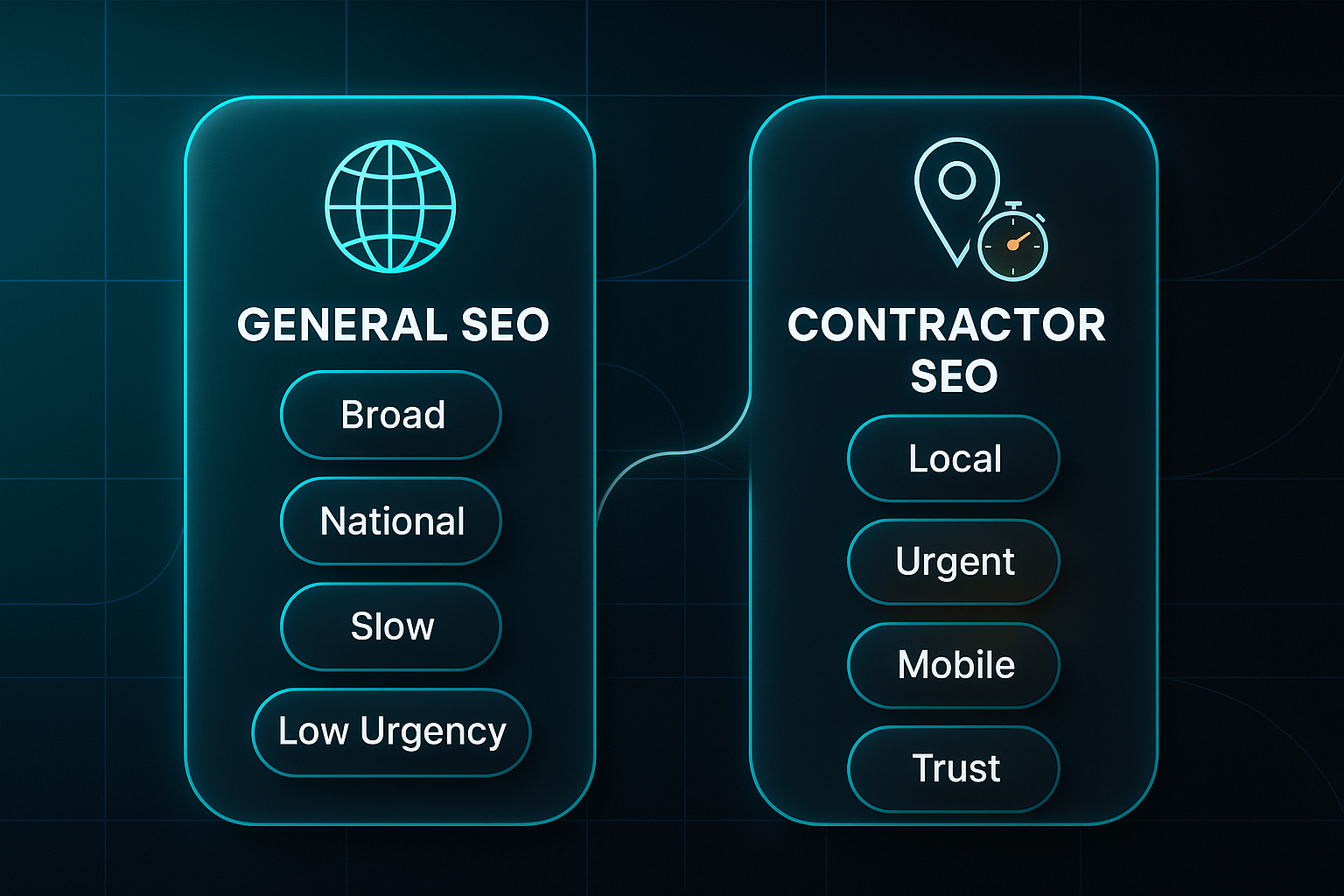
Unlike broad SEO, contractor SEO is tightly focused on connecting local, often urgent customers to the right professionals. The whole point is to ensure your business is visible the moment someone in your area needs your service.
But what makes this unique? With contractors, timeliness is everything. Someone with a leaking radiator or a blown fuse usually isn't planning ahead—they want help fast.
Why Contractor SEO Differs from General SEO Practices
You might ask, why not just use general SEO tactics? Here’s where contractor SEO stands out: it’s built for local, high-trust, and time-critical searches.
Most UK searches for contractors are local, done on mobile phones by people needing quick solutions. Google’s algorithms pay extra attention to accurate business details, well-defined service areas, and contractor reputation.
Even a minor error—such as an inconsistent address or a single negative review—can block you from those top three ‘local pack’ positions.
There’s not much room for mistakes.
Building authority and a trustworthy reputation for contractors involves strategic Digital PR, which is a critical component for standing out in local search results.
To rise above these pitfalls, it’s important to understand the foundational elements of contractor SEO.
Foundational Concepts in Contractor SEO
So, what holds this strategy together? A handful of essential concepts shape contractor SEO:
- Local Visibility
Your address, coverage area, and business details all match up and make it easy to find you. - Trust-Building
Clients trust honest reviews, visible credentials, and real examples of good work. - Service Relevance
Detailed content describes each service and area, helping search engines match your site to real needs. - Citations and Service-Area Targeting
Consistency across every online directory and a clear list of covered locations put you on the map.
Why focus so much on these details? Even small things—like a typo or a missing profile—can mean missing out on calls that really matter.
A strong grasp of these principles helps contractors avoid costly mistakes and stand out online.
Mastering these fundamentals prepares you to succeed in the digital-first contractor landscape.
Context: Industry Landscape and Digital Competition
Here’s a statistic that says it all: 97% of UK clients now start by searching for a local business online.
Even more, 62% say positive reviews are the reason they choose one company over another.
But what does this mean for your business day-to-day? Only three contractors usually land in Google’s local pack at the very top. It’s a tough competition!
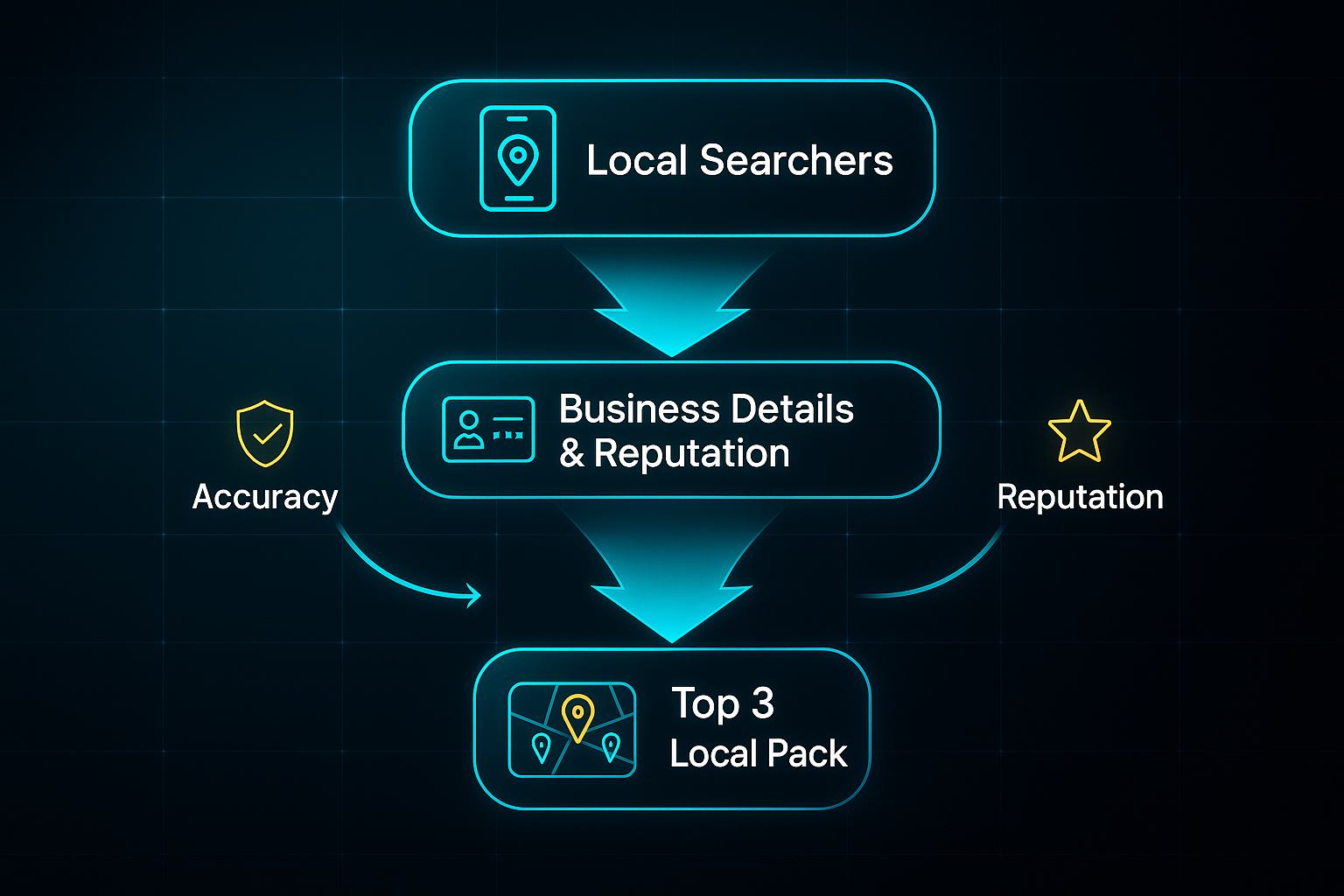
It really can make all the difference. Just one wrong address or negative review could see you vanish from those vital spots—showing how precise, positive reputation online has replaced the old word-of-mouth.
Google Reviews are projected to drive 81% of consumer decisions in 2025, solidifying their position as a primary influence on local business success.
This digital shift means your online presence now acts as your most important source of new business and client trust.
Knowing this, contractors must prioritise their reputation and online accuracy to stay competitive.
Key Terminology in Contractor SEO
Let’s define the most important terms before we move any further. These will pop up again and again:
- Local Pack
The top three map results in Google for any local contractor search, highly sought-after for visibility. - Citations
Business name, address, and phone details listed on third-party directories—must always be consistent everywhere online. - Google Business Profile
Google’s free, central business listing tool (formerly Google My Business), crucial for search. - Service-Area Targeting
Stating all towns, postcodes, and areas you serve, on both your website and online profiles.
These terms serve as the foundation for every aspect of your contractor SEO strategy.
E-E-A-T: Google’s Trust Framework
Ever heard of E-E-A-T? That stands for Experience, Expertise, Authoritativeness, and Trustworthiness—Google’s way of weighing if your site deserves to be at the top.
Demonstrating real project work, industry accreditations, and a string of happy client reviews helps tick the boxes for both search engines and potential customers.
Establishing these qualities is critical for both trust and visibility.
Trust Signals and Their Impact
Trust signals are the digital clues—like strong reviews, certificates, or rapid response rates—that prove your business is reliable.
The stronger and more obvious these are, the better your chances of winning both top rankings and client enquiries.
Understanding all these key points gives contractors a clear edge in today’s world—where digital discovery has replaced old-fashioned recommendations.
All of this puts you on solid footing as we move into action-focused, business-boosting SEO tactics next.
Why Contractor SEO Matters for Contractor Businesses
Lead Generation in the Digital Age
If you’re a contractor eager for more enquiries, it’s almost impossible to overlook how things have changed since 2023. These days, 97% of UK homeowners and business clients start their hunt for trades using Google, and three out of four reach for their mobiles first.
Word-of-mouth still exists, but online searches show higher intent than ever.
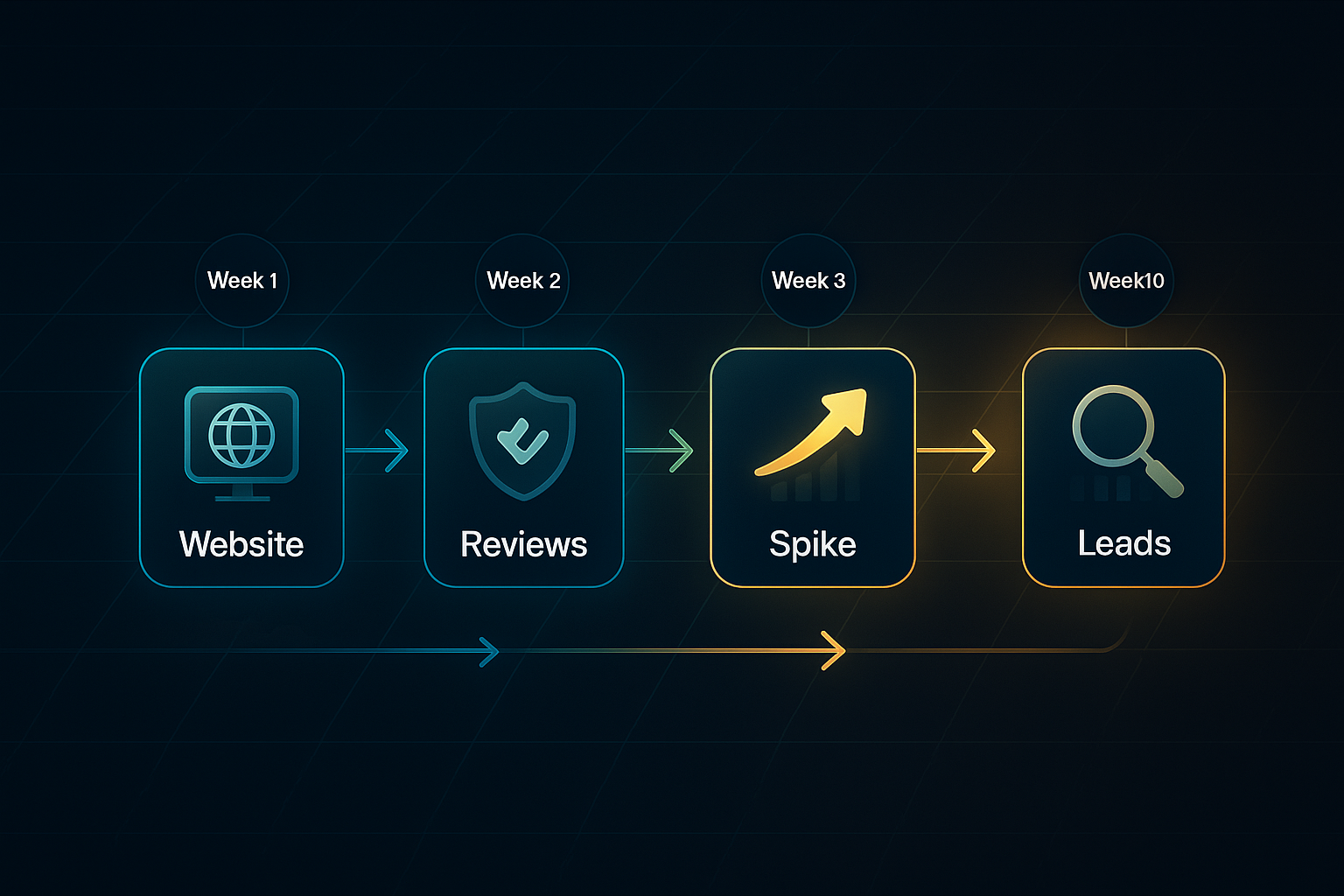
Take the case of Creations Building & Landscaping: their team rebuilt their website, optimised their Google Business Profile (GBP), and set up automated review requests through Birdeye.
What happened next? A 204% spike in visibility, 14+ local #1 keyword wins, and a flood of new client calls—all within ten weeks.
Here’s the key: clear navigation, accurate GBP info, and scheduled feedback requests.
The SEO workflow began with a comprehensive audit, followed by keyword research targeting high-intent, location-specific terms. The next steps included on-page optimization, technical fixes, content marketing, link building, and Google Business Profile optimization.
Most contractors adopting this workflow see lead growth in 6–12 weeks. The switch is fast—but the results last.
Local Search Advantages and Challenges
Let’s talk about the Google Local Map Pack—the top three results with map pins you see at the start of nearly every contractor search.
That’s where 48–52% of all clicks happen, making it the primary battleground for visibility.
To get there, attention to NAP consistency—matching your name, address, and phone everywhere—is non-negotiable. It’s checked across 20+ directories (with tools like BrightLocal).
Weekly photo uploads on GBP using OneUp take only 10–20 minutes.
Listing every postcode you cover and collecting 15–30 new 5-star reviews over ninety days gives you an edge.
Consider a Manchester electrician: after regular NAP audits, photo uploads, and automated review requests, they moved from #9 to #2 in the Map Pack and doubled monthly leads in just three months.
Those photo and review tasks? They easily fit in 10–20 minutes per week, with a 30-minute monthly audit.
ROI and Long-Term Impact of SEO
The magic of SEO isn’t just short-term spikes—it’s compounding growth.
As your website content, GBP engagement, and positive reviews pile up, your rankings and incoming calls rise together.
UK benchmarks show contractors routinely double their organic web traffic within 3–6 months via solid local SEO.
Hit the Map Pack’s top three, and your paid lead costs can drop by 25–40%.
A Manchester builder, for example, rebuilt their site, improved speed, and added schema markup—leading to a 50% surge in organic traffic and paid leads cut in half after six months.
Pain Points Solved by Smart SEO
Contractors face frustrating hurdles every week.
Fortunately, focused SEO strategies can tackle the worst offenders—which makes a real difference:
- Over-reliance on paid brokers
Spending £20–£75 for each lead. - Low-quality or unreliable leads
Poor web presence attracts mismatched jobs. - Low Map Pack ranking
More visible rivals win the urgent, local work. - Lack of reviews or poor scores
Conversion rates struggle, even for those ranking high. - Inconsistent NAP data
Clients and search engines lose trust in mismatched listings.
Let’s return to the Yorkshire plumber: they used BrightLocal for NAP audits, GatherUp for automated reviews, and launched postcode landing pages.
With those steps, they saw 60% more organic leads, 30% lower ad costs, and landed in the Map Pack’s top three within six months.
In my experience, all it takes is systematic weekly reviews, regular photo uploads, and monthly NAP checks to put even the smallest contractor on the map.
The result is simple: more—and better—enquiries without overspending on costly lead-broker platforms.
That’s why contractor SEO isn’t just a buzzword; it’s your route to sustainable, steady business growth.
Local SEO Strategies for Contractors
For contractors navigating 2025, nailing local SEO isn’t optional—it’s the lever that propels your business into the Google Map Pack and funnels high-quality, local leads your way.
This section lays out concrete, step-by-step workflows covering every vital pillar: your Google Business Profile (GBP), directory citations, top-converting landing pages, and schema markup.
And because nothing beats a real-world example, you’ll see metrics from actual UK and US contractors who’ve moved the needle.
Google Business Profile: Benchmarks, Steps, and Impact (2025)
Let’s start with your Google Business Profile, still the cornerstone for regional contractor SEO. If you want predictable results, you need a repeatable process.
Here’s the flow to lock in your visibility:
- Claim & Verify
Start at google.com/business. Make sure you claim your listing and verify it with your physical address—this typically wraps up in 3–14 days via postcard or phone. A utility bill with your business name can hurry things along. - Accurate Categories
Always select the most specific main category (like ‘Plumber’ rather than just ‘Contractor’). Add two or three secondary categories. It’s smart to revisit these every quarter, updating as your services expand or shift. - Complete GBP Fields & Media
It’s tempting to fill in the basics and walk away, but every field matters: NAP (Name, Address, Phone), hours, service areas, and your web address. At launch, upload at least 10 geo-tagged images and add new team or jobsite pictures each month. For visual trades like roofing or painting, before/after shots can be a clincher. - Ongoing Content & Engagement
Keep things fresh by posting weekly—special offers, service news, or even seasonal tips. Set up your top FAQs in advance, enable GBP messaging, and aim to answer every new enquiry within 24 hours (with an autoresponder for out-of-hours). - Reviews & A/B Testing
Proactively ask for five to ten new reviews monthly, using SMS or email links for convenience. Always reply, mention the job type or location, and experiment each quarter by A/B testing category choices. Run each variation for 60 days, then check the ranking changes. - Monthly Analytics & Validation
Dive into your GBP analytics monthly—your goal is a 100% NAP match, 25% or more extra calls and visits after 6–12 months, and a review count above 20 with a 4.5+ average rating.
Achieving these improvements shows real results in the field.
A UK roofing contractor, after implementing structured data improvements, tightening NAP consistency, and optimising GBP categories, shot up by 30% in top-3 Map Pack rankings and saw leads jump 20% in just three months.
Citation Tools: Selection Criteria & Real-World Results
Once your GBP is optimised, selecting the right citation tool is the next critical step in your local SEO workflow.
Choosing the right citation tool can make or break your local SEO. Let’s break it down so you can pick the right match:
- BrightLocal
Manual entry, niche directories, live tracking; best for UK/US SMBs needing granular NAP control. - Moz Local
Hands-off automation, quick directory sync; simple choice for small teams and core directories. - Yext
Enterprise-focused, bulk updates through API; fits large or multi-site operations. - Whitespark
Deep-clean, error repair; ideal for older firms needing a citation clean-up.
BrightLocal is the go-to for UK/US contractors who want precise control over listings—those who correct their citations every six months typically see their Map Pack position climb in three to four months.
Moz Local is great for those with 20–50 locations who want to set it and forget it.
Yext is worth the cost if you have hundreds of listings and need instant changes.
Whitespark steps in when you’re dealing with a legacy mess—a Bristol plumbing company fixed over 60 listings in two weeks with BrightLocal, saw a 32% jump in web calls, and moved from sixth to third in local rankings.
Building on authoritative citations, your next lever is the landing page.
Service & Location Landing Pages: Template, Testing, and Outcomes
Great landing pages are the backbone of local SEO for contractors.
The highest performers all stick to some classic essentials: a clear headline (think “Boiler Repair in Cardiff”), a concise introduction (100–150 words with your value pitch), segmented service lists with internal links, three to five authentic testimonials, and a job gallery with at least five labelled images.
Embed your contact forms or buttons above the fold, and always favour a single-column, mobile-optimised layout.
It pays to test monthly: check your calls-to-action work and aim for mobile load speeds under two seconds.
If you update every three months with fresh photos and examples, results usually show in three to six months—and conversions can soar by up to 200%.
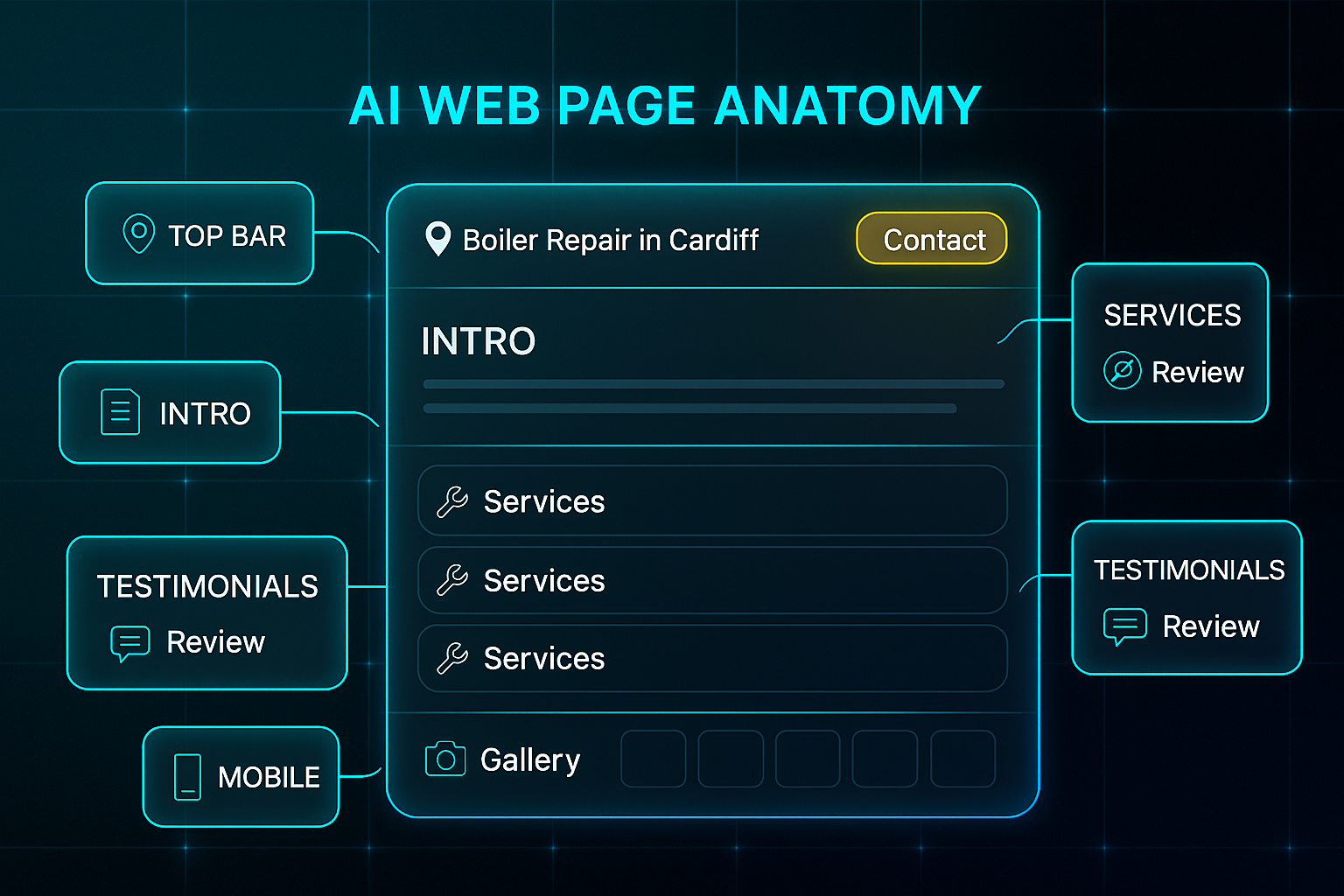
For example, an Oxford-based builder revamped their pages using this model and doubled their lead flow in under twelve weeks.
Turning to schema, your next task is to ensure every site has the right markup to boost results.
Schema Markup: Plugins, Key Fields, Validation, and ROI
Schema isn’t just for the tech crowd—it’s your shortcut to rich results and higher click-through rates. The right plugin makes all the difference:
- Rank Math Pro
Full schema automation and instant indexing for all-in-one, multi-location setups. - Yoast SEO + Local Add-on
Intuitive setup and focused schema for small or single-location businesses. - Schema & Structured Data for WP
Best if you want granular control and need to tailor fields like geo, service area, reviews, and photos.
Rank Math shines for complex, multi-service operations wanting automation.
Yoast and its Local add-on are perfect for solo trades or small firms after quick wins.
Schema & Structured Data for WP is better for the hands-on crowd needing detail-by-detail customisation.
Once you've chosen your schema tool, focus on completing the core fields: @type (LocalBusiness/Contractor), name, address, telephone, geo, description, opening hours, and reviews.
Each quarter, run Google’s Rich Results Test—aim for those green ticks next to each required schema field.
Contractors rolling out full schema routinely report a 15–40% lift in click-through rate and fresh rich results.
In a world where every lead counts, these are the tweaks that separate the leaders from the crowd.
Contractor Website SEO Best Practices
How to Make Every Service and Location Page a Local Lead Magnet
Ever wondered why some contractor websites consistently attract more calls than others? Often, it's how every service and location page is put together—small choices add up to big differences.
To maximise local leads, you need each contractor page optimised individually with high-intent, local keywords. This means working urgent, local terms—like “Emergency Boiler Repair in Leicester”—right into your titles, H1s, meta descriptions, and on-page text.
The contractors who rank best do more than use the right keywords. Their service pages provide clear detail: step-by-step outlines of the process, the materials used, and expected timelines for urgent work. Above-the-fold trust signals are essential too.
Here’s what makes a service page stand out:
- Detailed FAQ
Answer pressing concerns (for instance, “How quickly can you attend site?”) right on the page. - Visible Reviews
Display Google reviews and accreditation badges where clients can see them instantly. - Authentic Imagery
Before-and-after photos, location-stamped galleries, and project images build regional trust. - Instant Contact Options
Provide a tap-to-call CTA and instant enquiry form above the fold.
Top-performing contractors refresh their content and images quarterly, leading to as much as a 200% increase in inbound calls within 12 weeks.
Mobile Experience That Wins Urgent Local Searches
Let’s talk about where most clients actually find you: their phones.
In 2025, over 70% of contractor leads come in from mobile.
You’ll stand out by making your site easy for on-the-go prospects. A mobile-friendly contractor site should include these essentials:
- Scroll & Tap Simplicity
Pages should glide smoothly; autofill-enabled forms speed up action. - Always-On CTAs
Sticky tap-to-call or “Book Visit” buttons remain visible as users scroll. - Short Forms
Keep it to only 3–5 fields, no more. - Speed Compliance
Meet Google Core Web Vitals—page loads under 2.5 seconds (LCP), FID below 100ms, and CLS under 0.1.
Want a smoother workflow? Use TinyPNG or ShortPixel for image compression—automate this step on WordPress sites.
Check your mobile site weekly with Google PageSpeed Insights and Search Console’s Mobile Usability report.
Fix red flags the same day; delayed action costs you leads.
Technical Health: The Silent Driver of Contractor Rankings
The performance you see online depends on what’s going on under the bonnet. Your technical SEO setup is quietly boosting—or losing—your leads.
Here’s a checklist to keep your technical foundations strong:
- Enforce HTTPS/SSL
Without SSL, you could lose up to 30% of mobile leads. - Streamline Navigation
Limit menus to core services, locations, reviews, gallery, and contact. - Local-Friendly URLs
Use structures like /gas-boiler-repair-bournemouth with relevant keywords. - Monthly Audits
Use Screaming Frog (free up to 500 URLs), SEMrush Site Audit, or native Wix/Squarespace tools to spot issues. - Sitemap Updates
Upload a revised XML sitemap to Google Search Console after major changes.
Contractors solving technical issues such as broken links or slow pages are rewarded with 10–17% longer session times and significantly better site indexing.
With your technical foundation in place, here’s how internal linking and schema markup can multiply your reach across all pages.
Internal Linking and Schema: Multiply SEO Value Across All Pages
Getting the basics right is great, but internal linking and schema markup can multiply your reach.
Here are the actions that yield the best results:
- Pillar Service Pages
Build main “pillar” pages for your top services. - Smart Anchor Text
Link blogs, locations, and galleries using keyword-rich anchors. - Quarterly Link Review
Tools like Screaming Frog, Link Whisper, or AIOSEO help find and fix orphaned pages. - Add Schema Markup
Apply LocalBusiness or Contractor schema for structured data on services, reviews, areas, and NAP details. - Validate Regularly
Run Google’s Rich Results Test every quarter to check schema health. - Project Photos
Upload location-stamped images with schema and alt text for extra trust and SERP appeal.
Schema enhancements drive 20–30% higher click-through rates via prominent star ratings, FAQs, and project images in Google results.
Get these essentials lined up, and your website will start pulling in the leads—like clockwork.
Content Strategies for Contractor SEO
Winning more local leads in 2025 means your website needs to deliver trust and strong value at every turn. So, how do you speak to the way clients really search for—and pick—a contractor? Let’s break down the content structure methods that boost your visibility and turn prospects into solid enquiries.
Service & Location Pages: Anchor for Local SEO
Every service and location you cover deserves its own dedicated, optimised page. Why? Because using geo-targeted keywords in your H1, meta titles, and content (picture “Kitchen Fitter in Bristol”) makes you instantly relevant in local searches.
And don't stop there—pop in real client testimonials, short case studies, and genuine project images from that area.
Add in neighbourhood or town-specific details and highlight your current credentials or insurance badges to hit trust and regulatory needs head-on.
The secret sauce? Rotate fresh reviews and project photos in every quarter.
Contractors who stick to this see call-in rates double and rise up the ranks—both in Google’s local Map Pack and organic search.
Project Galleries: Visual Proof that Converts
Want visitors to turn into callers? Show off your work with before-and-after images, each captioned with location and results.
Keep images compressed under 100KB—it’ll help your site load fast.
Here’s another tip: use descriptive file names and alt text (like “bathroom-renovation-bristol-may-2025.jpg”).
Don’t forget to implement ImageObject schema so your gallery can show up in Google’s image and rich results.
The impact is real—contractors who organise galleries by service, area, or job type and use short video walk-throughs (with simple upload tools) enjoy up to 40% more on-page actions.
Blogging Built On Real Contractor Questions
Your best blog topics come straight from real life: project notes and CRM logs.
Spot those recurring client questions—the ones that pop up most (“How long does a bathroom refurb take in Bristol?”).
Zero in on seasonal jobs, regulation changes, and guides for what clients should expect.
Target specific questions and add in local checklists or calculators to boost engagement.
Here’s the metric to watch: tag call-to-actions with UTM parameters and measure using Google Analytics.
Contractors who keep blogs locally optimised and relevant report 20–60% more qualified leads than those posting generic articles.
Blog-in-one-minute
Add a fully SEO-optimised blog to your website with just 2 lines of code.
Learn more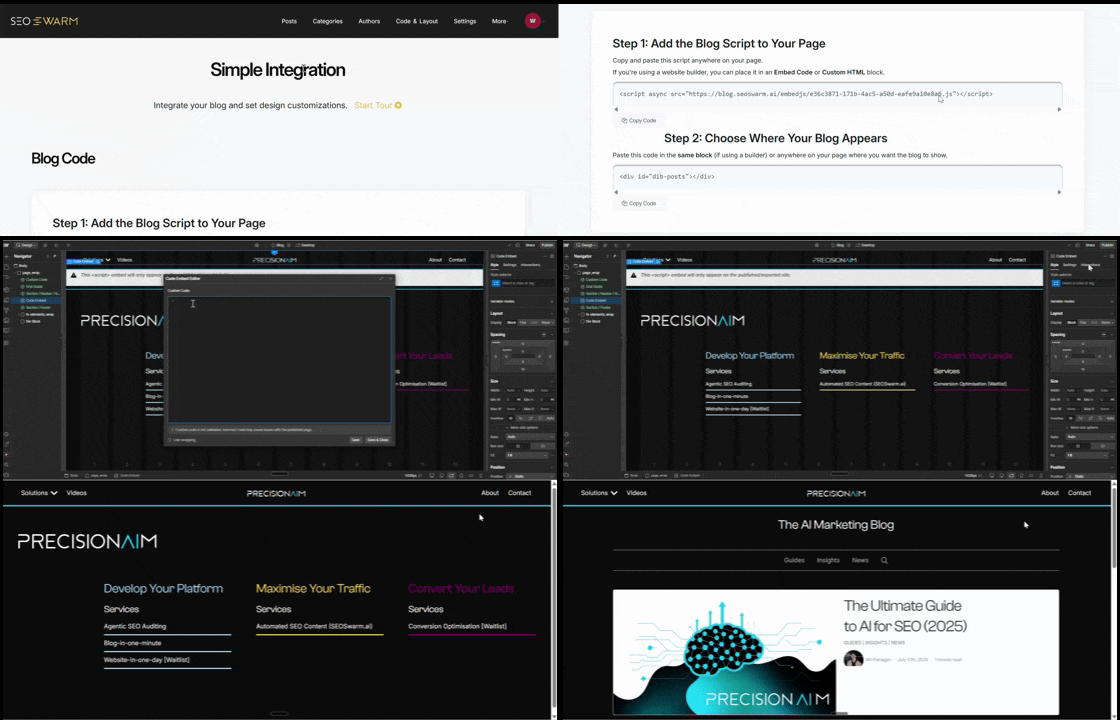
Voice-Optimised FAQs & Review Automation
FAQs need to go beyond the basics—make them location- and service-specific.
Answer real, urgent queries in everyday language—think voice assistant searches (“How soon can you fix a leak in Bath?”).
Use FAQPage schema and update questions every month by checking site searches and direct messages.
For reviews, prompt satisfied clients with SMS or email requests straight after the job’s wrapped up.
Tag reviews with schema and display them right under key CTAs and your project gallery.
This not only lifts your click-through rate but keeps your reputation robust across Google and other platforms.
You’ll be surprised—sticking to regular review capture and FAQ updates can be the turning point for maintaining trust, winning more clicks, and defending your standing online.
Reviews and Online Reputation Management for Contractors
High-quality reviews have become the backbone of contractor SEO in 2025. They influence your ranking in Google’s local pack, entice more people to click, and drive new enquiries to your business.
Aim for 40–50+ Google reviews and keep your average above 4.5 stars. Contractors hitting these marks regularly see up to three times the conversion rate compared to less-reviewed competitors.
Generating and Managing Reviews Effectively
Automating review requests relieves pressure and saves time. Four leading UK platforms for 2025—Podium, Birdeye, Grade.us, and Reviewshake—make collecting and displaying feedback far simpler.
Each offers straightforward integration. WordPress users install a plugin, while Squarespace or Wix users connect via Zapier or an API.
This means you can showcase reviews easily—no technical hassle required.
Here’s how these leading review tools compare for UK contractors:
| Platform | UK Price (monthly) | Key Features | Google Review Growth (3–6 mo) | Local SEO Impact |
|---|---|---|---|---|
| Podium | £300–£600+ | SMS/email reviews, unified inbox, Google focus | 20–50% | Strong |
| Birdeye | £220–£500+ | Multi-platform, AI analytics, competitor track | 50–70% | Very strong |
| Grade.us | £80–£110+ | Multi-platform, white-label, reporting | 20–40% | Moderate |
| Reviewshake | £50–£100+ | Review collection, analytics, white-label | 15–30% | Basic |
If rapid review growth is your goal, Birdeye leads with 50–70% more reviews in six months. Podium is best for those prioritising mobile, using fast SMS requests and direct Google links.
Grade.us works well for agencies or smaller firms wanting white-label reporting. Reviewshake covers only the essentials and fits tighter budgets.
Getting your system set up is simple. Here’s how to connect your platform:
- WordPress Integration
Install the plugin and link your account. - Squarespace/Wix Integration
Use Zapier or API, then add the review widget to your site.
Stick with 40+ reviews and a 4.5+ average rating. You’re far more likely to double or triple your local pack clicks and drive consistent leads.
Handling and Responding to Negative Feedback
Reply to negative reviews within 48 hours to show you care. Address concerns directly, and when possible, move the chat offline.
Modern review platforms provide real-time alerts and let you flag unfair comments. If you fix a problem, you can ask for an updated review—just never offer incentives.
Expanding Visibility Through Reputation Channels
It isn’t enough to focus on Google. Claim and update profiles on Facebook, Yelp, Houzz, Angi, and trade directories.
Run a monthly NAP (Name, Address, Phone) check with Moz Local or BrightLocal to keep your details accurate and penalty-free.
Showcase trust badges, accreditation, and awards, especially in your footer or About page. Add LocalBusiness schema to help search engines understand these trust signals.
Contractors who do this see 15–25% higher click-through rates and stronger local rankings.
AI-powered reputation tools are standard in 2025. They spot negative trends quickly, so you can step in before your ranking or reputation takes a hit.
A consistent, proactive review process is no longer optional—it’s your edge for standing out and winning the best local projects this year.
Measuring Contractor SEO Success and Optimising Performance
KPIs and Targets: What to Track
To really move the needle, you need to focus on the KPIs that fill your calendar with booked jobs and strong, local leads. Forget chasing after surface-level statistics—what counts are the numbers tied directly to growth you and your team can see.
Smart contractors use a tight set of metrics: organic traffic growth in Google Analytics 4, Map Pack rankings for your most valuable keywords (tracked in BrightLocal), Google Business Profile actions like calls and directions, conversion rates on enquiry forms and phone calls, and review volume using platforms like Birdeye or Podium.
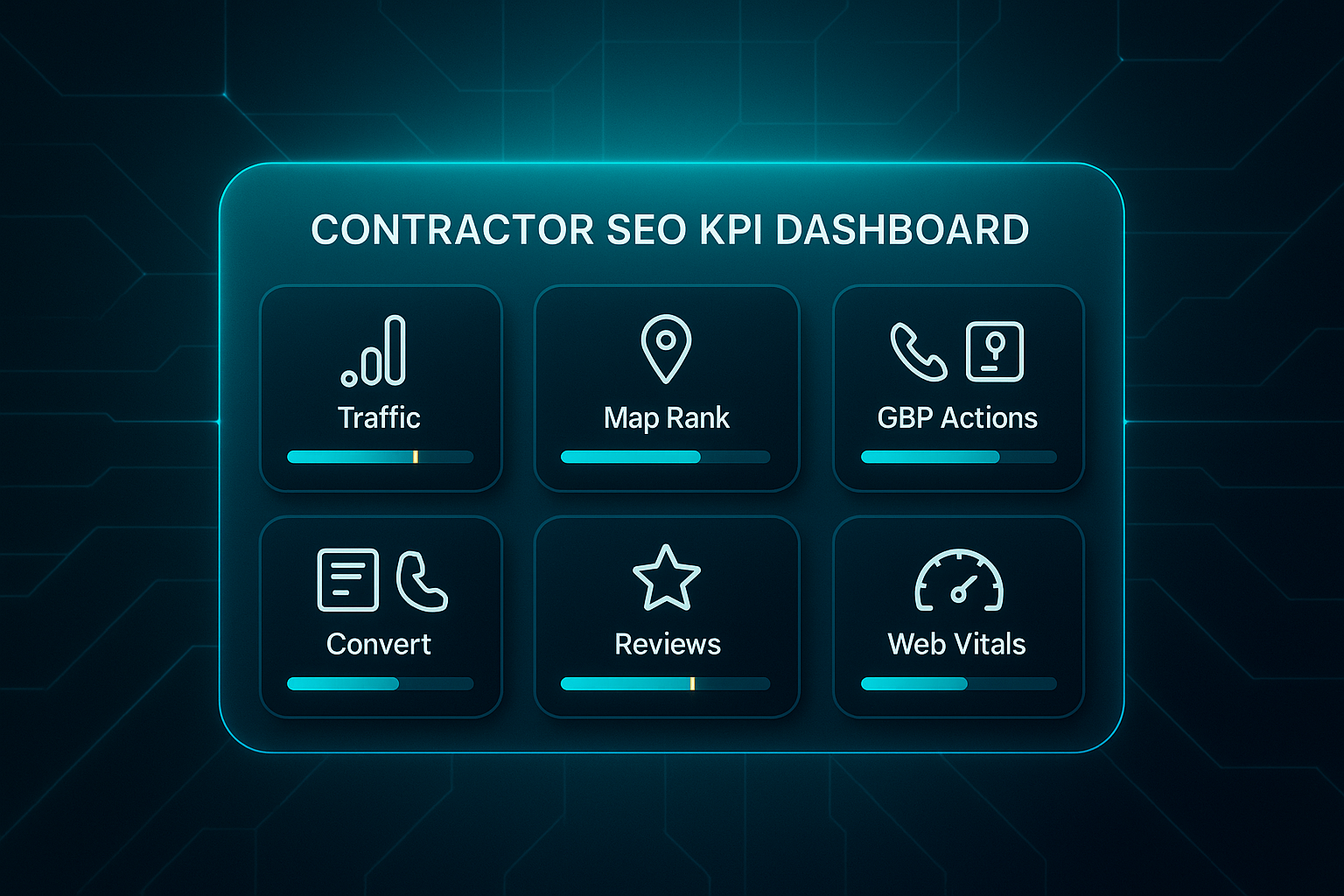
Don’t ignore Core Web Vitals for site speed and stability.
Meaningful targets look like 10–20% monthly organic growth, at least a 5–8% conversion rate, and a 4.5+ average review score.
The result? A UK plumber who followed this system—tracking keywords, improving pages, reacting fast—saw a 40% jump in visibility and quarterly revenue up by 25%.
Monthly and Quarterly Reporting: Stepwise Implementation
Regular reviews are your safety net against nasty surprises and missed opportunities. The monthly review serves as an early warning system and a way to keep steady momentum, while the quarterly review lets you adjust strategies and seize big wins. Both cycles give you a structure to spot issues and measure what’s really working.
Monthly reviews catch the bumps and dips before they become real headaches. Give yourself (or your team) 45–60 minutes every month to work through the essentials below. This rhythm turns insights into action, so routine issues never pile up and small successes get magnified.
- Export organic sessions and conversions
Pull from GA4 and compare with last month’s data to reveal trends. - Download Map Pack rankings and reviews
BrightLocal shows shifts in your local standing and online reputation. - Check Search Console indexation and queries
Confirm no technical faults block priority services and spot what content’s gaining or slipping. - Pull lead reports by channel
Use lead tracking tools to match leads to jobs in your CRM system. - Share your dashboard
Distribute a one-page summary on WhatsApp or Slack, and assign dips for deeper review.
Quarterly reviews let you pause for the bigger picture. These sessions don’t just fix what’s broken—they sharpen your edge for seasonal trends, target big wins, and keep the whole team in step.
Before starting the checklist, remember: quarterly reviews are when you go deep, connect shifts with business outcomes, and plan bold improvements for your weakest service areas.
- Run a technical SEO audit
Use tools like Screaming Frog or SEMrush to highlight hidden flaws and technical gaps. - Assess service/location page performance
Compare bounce, conversion, and speed; updating lagging landing pages with clear targets. - Evaluate seasonal and project trends
Look for signals like a +35% winter boiler call surge and adapt content or focus—this is where proactive contractors get ahead.
Win points every time you lift a lagging page or win a new Map Pack spot after a targeted change.
Connecting SEO to Booked Jobs: Lead Attribution
Want to know which of your efforts actually win business? Assign a call tracking number to each landing page, tag every form with UTMs, and log every lead in your CRM. This way, you can trace each booked job to SEO wins—not guesses. An Oxford roofer did this and doubled bookings just by following the evidence.
Automated Auditing and SEOSwarm
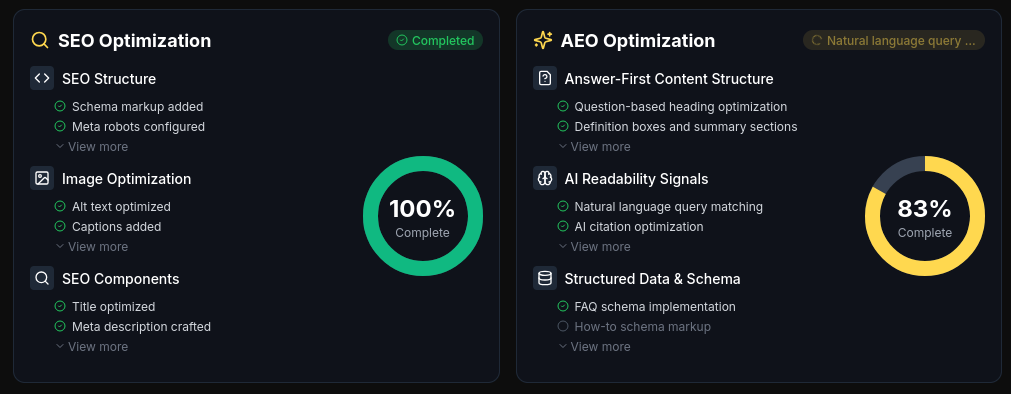
Manual checks take far too long. SEOSwarm’s AI-powered scans spot SEO errors quickly. With flexible article audits and contractor-focused packages, you get fast alerts for ranking, content, or technical gaps, so nothing slips by.
Timeframes, Outcomes, and Troubleshooting Benchmarks
Aim for clear metric improvements in each monthly review, and flag any result that drops by 15% for fast action. Each quarter, expect a new Map Pack ranking, a 2%+ conversion boost, or a stubborn technical fix resolved. When stalled, compare your dashboards to competitors and try new analytics-driven adjustments. Always check GDPR when sharing client or financial data.
This discipline—lean metrics, tight attribution, and fast fixes—lets contractors reliably double annual leads and keep their pipeline strong.
Armed with these tracking and review strategies, you’re now set to implement the technology foundations that power contractor SEO.
Common Contractor SEO Pitfalls and How to Avoid Them
Every contractor chasing more leads hits roadblocks sooner or later—inevitably, the pitfalls pile up. The difference is all in how fast you can spot and overcome them. Rapid fixes, defined benchmarks, and straightforward workflows will keep your search visibility high, even when issues creep in.
SEO Self-Audit: Quick Checklist
Frustrated by sluggish SEO results and not sure where things are going wrong? You’re definitely not alone—most setbacks are easy to diagnose, if you know what to look for.
- Map Pack low rank
Align your Google Business Profile categories with top-performing local competitors, upload at least 20 photos initially (and new ones monthly), secure 5+ Google reviews every month, and run a full BrightLocal audit to ensure 100% NAP (Name, Address, Phone) consistency. - Sluggish review growth
Fire off automated review requests after every job (ideally 90%+ of clients), aim for at least 2 reviews per month, double-check your mobile review funnel, and watch for fresh feedback in GBP (Podium or Birdeye make this easy). - Low mobile conversions
Guarantee load speed under 2.5s with PageSpeed, keep enquiry forms and CTAs visible above the fold, fix anything that pushes your error rate over 5%, and sort technical snags flagged in Search Console.
Escalation: Workflow for Persistent Issues
But what if you stick to the script and still hit the same snags? It’s maddening, isn’t it? That’s the moment you need to dig deeper and escalate.
- Map Pack rank unchanged
Run a Screaming Frog audit, check for duplicate or orphaned pages, validate your schema using Google’s Structured Data Testing Tool, and clean up stale citations with BrightLocal. - Reviews flat after automation
Pull your client list, then personally call or text your top 20 customers—this often gives you a 10–20% bump in reviews within a month. - Mobile speed issues linger
Move images to a CDN, upgrade your hosting, or streamline scripts for the next load-speed cycle. Expect at least 30% faster results after changes.
Quick-Reference Problem Table
Ever wondered why your Map Pack ranking just…won’t budge? Here’s a table you can glance at to quickly tie symptoms to solutions and benchmarks:
| Symptom | Root Cause | Action | Benchmark | Tool |
|---|---|---|---|---|
| Ranking stuck at #5 | NAP mismatch | Update via BrightLocal | Up 2 positions/45 days | BrightLocal |
| Review plateau at 40 | Missed requests | Automate, manual follow-up | +10/60 days | Podium/Birdeye |
| Low mobile conversion | Form issues | Move/fix form | >4% conversion | PageSpeed/form plugin |
| Non-local leads | Service areas incomplete | List locations in GBP/site | 80%+ local leads | GBP audit |
| Traffic drop | Google update | SEMrush audit | Normal in 6–8 weeks | SEMrush, Search Console |
Manual vs Automated Troubleshooting: Core Use Case
So, when should you go hands-on, and when do you let a tool do the heavy lifting? Manual fixes—like updating Podium automation or personally nudging your top clients—should add at least 10 new reviews in 45 days, with setup only taking around 2 hours and half an hour each week.
By contrast, SEOSwarm shines for batch-auditing posts and plugging schema gaps across your site. It’ll fix and publish changes—all in one go—often delivering 30% or better speed gains and 24–72 hour indexing. If your manual effort hasn’t worked after a month (less than 50% improvement), that’s when automation becomes your best friend.

AI-Powered
SEO Content Strategy
See the AI platform that's replacing entire content teams
(with better results).

Industry Benchmarks for Performance
Let’s talk results, because measurement is what keeps you honest:
- Map Pack improvement
A 2–4 spot jump within 45 days after NAP and review fixes. - Automated review campaigns
Look for a 15–25% increase within two months if you send 100+ requests monthly. - Mobile conversion rates
Top performers see 4–8%. Under 2%? Something’s off in your mobile setup. - Technical fixes
See traffic/conversion rises inside 2–4 weeks after a technical audit.
Applying these structured audits and bold, action-focused fixes helps contractors break free from those typical SEO plateaus and keep the enquiries rolling in.
Now, it’s time to dig into how the top contractor SEO platforms and automation tools stack up—features, pricing, and all the details for SEOSwarm and the competition.
Tools and Platforms for Contractor SEO: Building Your Winning Tech Stack
Choosing the right SEO tools is less about collecting shiny objects and more about aligning each platform to your current business shape and ambitions.
Whether you’re a sole trader, small crew, or a multi-site contractor, the mix that wins for you is the one built for where you are now—without being weighed down by “tech for tech’s sake.”
Top Tools and Use Cases by Contractor Type
Let’s map out the leading platforms for 2025 and which contractor profiles they truly fit:
| Contractor Type | Key Platform(s) | Fit/Pricing | What It Solves | Typical Result/ROI |
|---|---|---|---|---|
| Solo Operator | Moz Local, Podium, SEOSwarm | $14–$299/mo | Fast citation sync, automated reviews, instant blogs | 20–50% more Map Pack visibility |
| Small Team | BrightLocal, Podium, Birdeye | $29–$499/mo | Unified reviews, multi-listing, analytics | +25–40% local rank & enquiries |
| Multi-Location/Franchise | Yext, Birdeye, SEMrush, SEOSwarm | $199–$1,000+/mo | Bulk updates, cross-region dashboards, AI audit | 40–60% faster update/accuracy |
| DIY/Full Control | WordPress+Rank Math, Screaming Frog | Free–$99/yr (tool); $299/yr (audit) | Custom blogs, technical SEO | 10–25% more organic traffic |
Before making your call, it’s wise to understand how these platforms each deliver practical value.
Here are quick-glance summaries, helping you spot which features or outcomes matter most for your business.
Essential Platform Snapshots
- Moz Local
Automated NAP updates make it perfect for solos and small teams. Cardiff builders typically see 25% more calls in 90 days. - BrightLocal
All-in-one for reviews, audits, tracking—expect a 25–35% ranking boost after consistent use. - Yext
Suited to franchises needing instant updates to 50–250+ locations. Can cut duplicate listings by 60% across your network. - Podium
Sends post-job SMS review requests; solos and small teams regularly get 20–30% more Google reviews in six months. - Birdeye
Gives real-time review dashboards for multi-location or small teams—often delivers 40% more positive reviews. - SEOSwarm
Enables AI-powered audits and blog launches (from $99/article), driving 30–50% faster local ranking gains. - Screaming Frog/WordPress
If you want custom blogs and deep technical audits, expect 15–25% better organic rankings with consistent effort.
If you’re a solo operator or small crew, definitely lean towards automation-first platforms—Moz Local, Podium, or SEOSwarm can rapidly win you more reviews and Map Pack visits.
Larger or multi-location contractors get the biggest upside from platforms offering bulk updates and competitor tracking—Yext, Birdeye, and SEMrush shine in this territory.
No matter your business size, trialling just one tool in a single region or for one branch, then tracking the effect on Map Pack ranking, calls, and review total over 6–12 weeks, is the safest way to measure impact before rolling out more widely.
Every investment should link directly to higher rankings and—crucially—more booked jobs.
Of course, technology doesn’t stand still. Up next: how to future-proof your contractor SEO strategy so you stay ahead of every algorithm update in 2025 and beyond.
Keeping Up with Contractor SEO Changes: Trends and Ongoing Tactics
Contractor SEO in 2025 doesn’t slow down for anyone. With AI-driven Google updates and the ongoing boom in voice and local search, you can’t just take your eye off the ball. Staying ahead means using trusted information sources, developing smart maintenance routines, and tapping into automation tools that make sense for the way contractors work.
Stay Updated: News, Alerts and Essential Resources
So, how do you keep from being blindsided when Google’s algorithm changes without warning? Start by subscribing to contractor-focused guides like LeadNurtureClose’s “2025 Guide to SEO for Contractors,” TrafficRadius, and the Google Search Central Blog. Set up Google Alerts with keywords like “contractor SEO update” or “Map Pack ranking” so you’re never caught off guard.
When you spot news of a major algorithm shift or policy update, download new checklists and playbooks. For practical, hands-on strategies, webinars from ServiceTitan and Contractor Marketing Pros regularly break down urgent changes—from GBP tweaks to review automation. Review these resources monthly and after each significant Google update to keep your knowledge fresh.
Routine Contractor SEO Maintenance
Skipping regular checks could leave you open to dropping Map Pack rankings or missing new lead opportunities. These quick routines help avoid surprise slumps that cost you business, especially after a Google change:
- Quarterly audits
Run Screaming Frog, SEMrush, or SEOSwarm for technical issues, citation accuracy, and schema markup. - Mobile & speed checks
Achieve load times under 2.5s and FID below 100ms—a must for urgent voice/local searches. - Content refresh
Update service/location pages and FAQs after algorithm changes. Use Birdeye or BrightLocal for alerts on NAP and Map Pack issues.
Automation with SEOSwarm: Contractor-Specific Advantages
This is where SEOSwarm becomes a true time-saver. With tools like blog-in-one-minute, live Map Pack ranking alerts, and automated audits for routine fixes, you skip the technical hassle. Solo traders get fast setup and blog/FAQ refreshes; larger teams benefit from batch dashboard actions and scalable, per-article plans. Crucially, all automation focuses on lead capture—keeping your business out in front, no matter how often Google changes direction.
Commit to steady news-checking, clever routines, and smart use of automation, and you’ll not only keep pace—you’ll find yourself ready for every SEO curveball 2025 throws your way.
Making Contractor SEO Work for You
Most contractors lose out not because they lack skill, but because their online presence doesn’t match their real-world reputation. I’ve seen even the best trades miss urgent leads simply due to a missing review, a slow mobile site, or an outdated Google Business Profile.
Here’s what I recommend: Pick one workflow—GBP optimisation, citation clean-up, or review automation—and commit to it for the next 30 days. Track your Map Pack ranking, review count, and inbound calls weekly. If you hit a wall, escalate with a technical audit or try an automation tool like SEOSwarm to multiply your results.
Contractor SEO isn’t about chasing every trend; it’s about building trust, fixing what’s broken, and showing up when it matters most. The contractors who win are those who treat their online presence with the same care as their best jobsite. Your next client is searching right now—make sure you’re the one they find.
- Wil